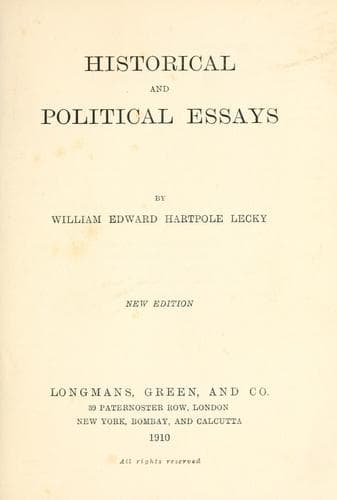
Historical and Political EssaysLecky, William Edward Hartpole
History
Historical and Political Essays
Lecky, William Edward Hartpole
History; Political science
Those portions which are most discordant
with our fresh knowledge will be neglected or attenuated. Although
they may not be openly discarded, they will cease to be realised or
vitally operative.
In the sphere of politics a similar law prevails, and the fate of
nations largely depends upon forces quite different from those on
which the mere political historian concentrates his attention. The
growth of military or industrial habits; the elevation or depression
of different classes; the changes that take place in the distribution
of wealth; inventions or discoveries that alter the course or
character of industry or commerce, or reverse the relative advantages
of different nations in the competitions of life; the increase and,
still more, the diffusion of knowledge; the many influences that
affect convictions, habits and ideals, that raise, or lower, or modify
the moral tone and type--all these things concur in shaping the
destinies of nations. Legislation is only really successful when it is
in harmony with the general spirit of the age. Laws and statesmen for
the most part indicate and ratify, but do not create. They are like
the hands of the watch, which move obedient to the hidden machinery
behind.
In all this kind of speculation there is, I believe, great truth, and
it opens out fields of inquiry that are of the utmost interest and
importance. I have, however, long thought that it has been pushed by
some modern writers to extravagant exaggeration. As you well know,
there is another aspect of history, which, long before Carlyle, was
enforced by some of the ablest and most independent intellects of
Christendom. Pascal tells us that if Cleopatra's nose had been
shorter, the whole face of the world might have been changed, and
Voltaire is never tired of dwelling on the small springs on which the
greatest events of history turn. Frederick the Great, who was probably
the keenest practical intellect of his age, constantly insisted on the
same view. In the vast field of politics, he maintained, casual events
which no human sagacity can predict play by far the largest part. We
are in most cases groping our way blindly in the dark. Occasionally,
when favourable circumstances occur, there is a gleam of light of
which the skilful avail themselves. All the rest is uncertainty. The
world is mainly governed by a multitude of secondary, obscure, or
impenetrable causes. It is a game of chance in which the most skilful
may lose like the most ignorant. 'The older one becomes the more
clearly one sees that King Hazard fashions three-fourths of the events
in this miserable world.'
Public-domain text, read in full here on John Shaqi.
Reviews
Reviews
No reviews yet
Be the first to share your thoughts on this work.
Join the Discussion
Join the discussion
Sign in to leave a comment or review.
Sign InorCreate an account