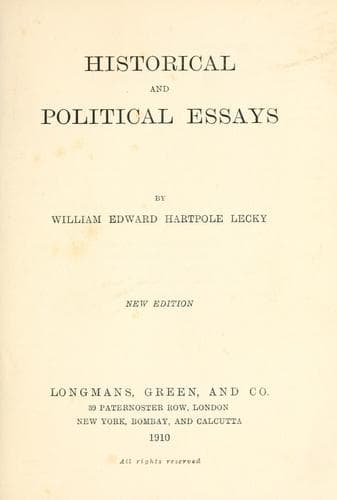
Historical and Political EssaysLecky, William Edward Hartpole
History
Historical and Political Essays
Lecky, William Edward Hartpole
History; Political science
In secular politics numerous instances of the same kind will occur to
every thoughtful reader of history. If, as might easily have happened,
Hannibal after the battle of Cannae had taken and burned Rome, and
transferred the supremacy of the world to a maritime commercial State
upon the Mediterranean; if, instead of the Regency, Louis XV. and
Louis XVI., France had passed during the eighteenth century under
sovereigns of the stamp of the elder branch of the House of Orange or
of Henry IV., or of the Great Elector, or of Frederick the Great; if,
at the French Revolution, the supreme military genius had been
connected with the character of Washington rather than with the
character of Napoleon--who can doubt that the course of European
history would have been vastly changed? The causes that made
constitutional liberty succeed in England, while it failed in other
countries where its prospects seemed once at least as promising, are
many and complex; but no careful student of English history will doubt
the prominence among them of the accidental fact that James II., by
embracing Catholicism, had thrown the Church feeling at a very
critical moment into opposition to the monarchical feeling, and that
in the last days of Anne, when the question of the succession was
trembling most doubtfully in the balance, his son refused to conform
to the Anglican creed.
Laws are no doubt in a great degree inoperative when they do not
spring from and represent the opinion of the nation, but they have in
their turn a great power of consolidating, deepening, and directing
opinion. When some important progress has been attained, and with the
support of public opinion has been embodied in a law, that law will do
much to prevent the natural reflux of the wave. It becomes a kind of
moral landmark, a powerful educating influence, and by giving what had
been achieved the sanction of legality, it contributes largely to its
permanence. Roman law undoubtedly played a great part in European
history long after all the conditions in which it was first enacted
had passed away, and the legislator who can determine in any country
the system of national education, or the succession of property, will
do much to influence the opinions and social types of many succeeding
generations.
Public-domain text, read in full here on John Shaqi.
Reviews
Reviews
No reviews yet
Be the first to share your thoughts on this work.
Join the Discussion
Join the discussion
Sign in to leave a comment or review.
Sign InorCreate an account