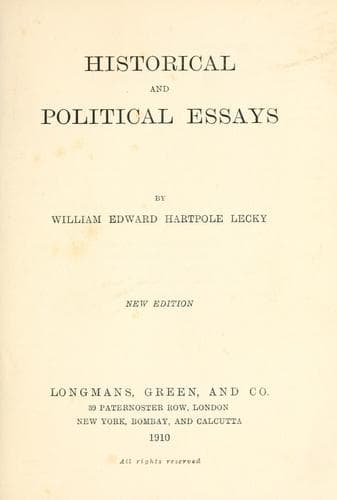
Historical and Political EssaysLecky, William Edward Hartpole
History
Historical and Political Essays
Lecky, William Edward Hartpole
History; Political science
My own view of this question is that though there are certain streams
of tendency, though there is a certain steady and orderly evolution
that it is impossible in the long run to resist, yet individual action
and even mere accident have borne a very great part in modifying the
direction of history. It is with History as with the general laws of
Nature. We can none of us escape the all-pervading force of
gravitation, or the influence of the climate under which we live, or
the succession of the seasons, or the laws of growth and of decay; yet
man is not a mere passive weed drifting helplessly upon the sea of
life, and human wisdom and human folly can do and have done much to
modify the conditions of his being.
It is quite true that religions depend largely for their continued
vitality upon the knowledge and intellectual atmosphere of their time;
but there are periods when the human mind is in such a state of
pliancy that a small pressure can give it a bent which will last for
generations. If Mohammed had been killed in one of the first
skirmishes of his career, I know no reason for believing that a great
monotheistic religion would have arisen in Arabia, capable of moulding
for more than twelve hundred years not only the beliefs, laws, and
governments, but also the inmost moral and mental character of a vast
section of the human race. Gibbon was probably right in his conjecture
that if Charles Martel had been defeated at the famous battle near
Tours, the creed of Islam would have overspread a great part of what
is now Christian Europe, and in that case it might have ruled over it
for centuries. No one can follow the history of the conversion of the
barbarians to Christianity without perceiving how often a religion has
been imposed in the first instance by the mere will of the ruler,
which gradually took such root that it became far too strong for any
political power to destroy. Persecution cannot annihilate a creed
which is firmly established, or maintain a creed which has been
thoroughly undermined, but there are intermediate stages in which its
influence on national beliefs has been enormously great. Even at the
Reformation, though more general causes were of capital importance,
political events had a very large part in defining the frontier line
between the rival creeds, and the divisions so created have for the
most part endured.
Public-domain text, read in full here on John Shaqi.
Reviews
Reviews
No reviews yet
Be the first to share your thoughts on this work.
Join the Discussion
Join the discussion
Sign in to leave a comment or review.
Sign InorCreate an account