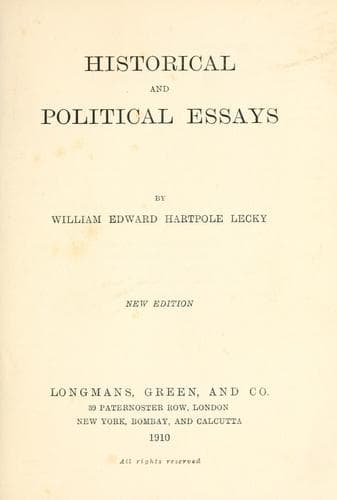
Historical and Political EssaysLecky, William Edward Hartpole
History
Historical and Political Essays
Lecky, William Edward Hartpole
History; Political science
ways of reasoning or feeling very different from his own. One of the
most valuable of all forms of historical imagination is that which
enables a writer to place himself in the point of view of the best men
on different sides, and to bring out the full sense of opposing
arguments. All these gifts or qualities are never in a high degree
united, but they are all essential to a great historian, and a true
school of history should widen instead of narrowing our conception of
it.
The supreme virtue of the historian is truthfulness, and it may be
violated in many different degrees. The worst form is when a writer
deliberately falsifies facts or deliberately excludes from his picture
qualifying circumstances. But there are other and much more subtle
ways in which party spirit continually and often quite unconsciously
distorts history. All history is necessarily a selection of facts, and
a writer who is animated by a strong sympathy with one side of a
question or a strong desire to prove some special point will be much
tempted in his selection to give an undue prominence to those that
support his view, or, even where neither facts nor arguments are
suppressed, to give a party character to his work by an unfair
distribution of lights and shades. The strong and vivid epithets are
chiefly reserved for the good or bad deeds on one side, the vague,
general and comparatively colourless epithets for the corresponding
deeds on the other side; and in this way very similar facts are
brought before the reader with such different degrees of illumination
and relief that they make a wholly different impression on his mind.
In the history of Macaulay this defect may, I think, be especially
traced. The characteristic defect of that great and in most respects
admirable writer, both as historian and artist, was the singular
absence of graduation in his mind. The neutral tints which are
essential to the accurate shading of character seemed almost wanting,
and a love of strong contrasted lights and shades, coupled with his
supreme command of powerful epithets, continually misled him. But no
attentive reader can fail to observe how unequally those epithets are
distributed and how clearly this inequality discloses the strong bias
under which he wrote.
The truth of an historical picture lies mainly in its judicious and
accurate shading, and it is this art which the historian should
especially cultivate. He will scarcely do so with success unless it
becomes to him not merely a matter of duty, but also a pleasure and a
pride. The kind of interest which he takes in his narrative should be
much less that of a politician and an advocate than of a painter, who,
now darkening and now lightening the picture, seeks by many delicate
touches to catch with exact fidelity the tone and hue of the object he
represents.
Public-domain text, read in full here on John Shaqi.
Reviews
Reviews
No reviews yet
Be the first to share your thoughts on this work.
Join the Discussion
Join the discussion
Sign in to leave a comment or review.
Sign InorCreate an account