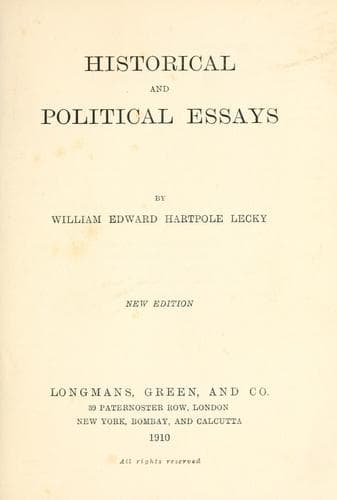
Historical and Political EssaysLecky, William Edward Hartpole
History
Historical and Political Essays
Lecky, William Edward Hartpole
History; Political science
The degree of certainty that it is possible to attain in history
varies greatly in different departments. The growth of institutions
and laws, military events, changes in manners and in creeds, can be
described with much confidence, and although it is more difficult to
depict the inner moral life of nations, the influences that form their
characters and prepare them for greatness or decay, yet when the
materials for our induction are sufficiently large this field of
history may be studied with great profit. Diplomatic history and the
more secret springs of political history can only be fully disclosed
when the archives relating to them have been explored and when the
confidential correspondence of the chief actors in them has been
published. The biographical element in history is always the most
uncertain. Even among contemporaries the judgment of character and
motives depends largely on indications so slight and subtle that they
rarely pass into books and are only fully felt by direct personal
contact, and the smallest knowledge of life shows how quickly
anecdotes and sayings are distorted, coloured, and misplaced when they
pass from lip to lip. Most of the 'good sayings' of history are
invention, and most of them have been attributed to different persons.
A history which is plainly written under the influence of party bias
has the value of an advocate's speech giving one side of the question.
When our only materials for the knowledge of a period are derived from
such histories, the saying of Voltaire should be remembered--that we
can confidently believe only the evil which a party writer tells of
his own side and the good which he recognises in his opponents. In
judging the historian we must consider his nearness to the events he
relates, his probable means of information and the internal evidence
in his narrative of accuracy, honesty, and judgment, and we must also
consider the standard of proof and the methods of historical writing
prevailing in his time. A modern writer who placed in the mouths of
his personages speeches which he himself invented would be justly
discredited, but in antiquity it was a recognised custom for a
historian to embody in fictitious speeches the reflections suggested
by his narrative and the motives which he believed to have actuated
his heroes.
Public-domain text, read in full here on John Shaqi.
Reviews
Reviews
No reviews yet
Be the first to share your thoughts on this work.
Join the Discussion
Join the discussion
Sign in to leave a comment or review.
Sign InorCreate an account