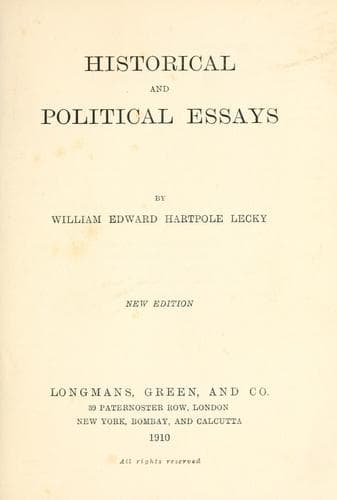
Historical and Political EssaysLecky, William Edward Hartpole
History
Historical and Political Essays
Lecky, William Edward Hartpole
History; Political science
The kind of interest which belongs to Irish history is curiously
different from that which attaches to the history of England and to
that of most of the great nations of the Continent. In very few
histories do we find so little national unity or continuous progress,
or such long spaces which are almost wholly occupied by perplexed,
petty internal broils, often stained by atrocious crimes, but turning
on no large issue and leading to no clear or stable results. Except
during the great missionary period of the sixth and seventh centuries,
and during a brief portion of the eighteenth century, we have little
of the interest that arises from dramatic situations or shining
characters, and in few countries has the highest intellect been, on
the whole, so slightly connected with the administration of affairs.
To a philosophical student of politics, however, Irish history
possesses an interest of the highest order. It is an invaluable study
of morbid anatomy. In very few histories can we trace so clearly the
effects of political and social circumstances in forming national
character; the calamity of missed opportunities and of fluctuating and
procrastinating policy; the folly of attempting to govern by the same
methods and institutions nations that are wholly different in their
characters and their civilisation.
The idea which still floats vaguely in many minds that Ireland, before
the arrival of the Normans, was a single and independent nation, is
wholly false. Ireland was not a nation, but a collection of separate
tribes and kingdoms, engaged in almost constant warfare. In this
respect, however, she resembled many countries which have since
attained the most perfect unity, and there can be little doubt that,
if her development had been impeded by no extraneous influences,
Ireland would have followed the same path as England or France. Much
stress has been justly laid on the disorganising influence of a long
succession of Danish invasions, though it must be remembered that
Ireland owes to the Danes the foundation of some of her most important
cities. Roman conquest, which introduced into most of Europe
invaluable elements of order, organisation, and respect for law, never
extended to Ireland. The Anglo-Norman invasion and conquest produced
consequences which were almost wholly evil. If the invaders had been
driven from the Irish shore, the natural course of development would,
no doubt, have been in time continued. If the invaders had completely
conquered Ireland, a fusion might have taken place as complete and as
healthy as in England. Neither of these two events occurred. The
English conquest was prolonged over nearly four hundred years. A
hostile and separate power was planted in the centre of Ireland
sufficiently powerful to prevent the formation of another
civilisation, yet not sufficiently powerful to impose a civilisation
of its own. Feudalism was introduced, but the keystone of the system,
Public-domain text, read in full here on John Shaqi.
Reviews
Reviews
No reviews yet
Be the first to share your thoughts on this work.
Join the Discussion
Join the discussion
Sign in to leave a comment or review.
Sign InorCreate an account