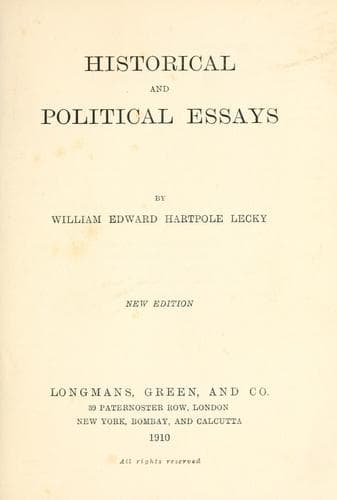
Historical and Political EssaysLecky, William Edward Hartpole
History
Historical and Political Essays
Lecky, William Edward Hartpole
History; Political science
a strong resident sovereign, was wanting, and Ireland was soon torn by
the wars of great Anglo-Norman nobles, who were, in fact, independent
sovereigns, much like the old Irish kings. The Scotch invasion of the
fourteenth century added enormously to the anarchy and confusion; the
English power as a living reality contracted to the narrow limits of
the pale; in outlying districts the Anglo-Norman assimilated quickly
with the Celtic element, while the English legislators in Ireland,
alarmed at the tendency, made it the main object of their policy, in
the words of Sir John Davies, 'to make a perpetual separation and
enmity between the English and Irish, pretending no doubt that the
English should in the end root out the Irish.'
Such a state of things continued till the long and terrible wars of
Henry VIII. and Elizabeth broke the power of the independent chiefs
and of the Celtic clans, and gave Ireland, for the first time, a
political unity. It is one of the great infelicities of Irish history
that this result was obtained at the very period of the Reformation.
The conquerors adopted one religion, while the conquered retained the
other, and thus a new and most enduring barrier was raised between the
two nations in Ireland, and a pernicious antagonism was established
between law and religion.
Another influence not less powerful than religion had at the same time
come into play. It had become the English policy to place great bodies
of English and Scotch settlers on the land that was confiscated in
consequence of rebellion, and under the impulse of the strong spirit
of adventure which grew up in the generation that followed the
Reformation, streams of English and Scotch adventurers poured over.
The great settlement of Ulster under James I. proved ultimately a
success, and laid the foundation of the prosperity of that province.
Other plantations were in time absorbed and assimilated by the Celtic
population; but vast revolutions in the ownership of land, accompanied
by the subversion of the old tribal customs, laid the foundation of an
agrarian war which still continues.
Religious and agrarian causes combined with the civil war in England
to produce the great rebellion of 1641 and the eleven years of
ghastly, exterminating war which followed. Hardly any page in human
history is more appalling. A full third of the population of Ireland
perished. Thirty or forty thousand of the most energetic left the
country and took service in foreign armies. Great tracts were left
absolutely depopulated, and after the rearrangement of land, which was
accomplished by the Act of Settlement, the immense preponderance of
landed property remained in the hands of the Protestant nation.
Public-domain text, read in full here on John Shaqi.
Reviews
Reviews
No reviews yet
Be the first to share your thoughts on this work.
Join the Discussion
Join the discussion
Sign in to leave a comment or review.
Sign InorCreate an account