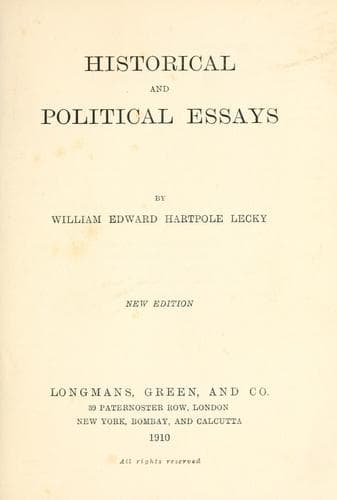
Historical and Political EssaysLecky, William Edward Hartpole
History
Historical and Political Essays
Lecky, William Edward Hartpole
History; Political science
Among living men, the strongest intellectual influence at that time in
Dublin was, I think, Whately, our archbishop, an original and powerful
thinker who has scarcely obtained a place in the literary and
intellectual history of his time commensurate with the wide and deep
influence he undoubtedly exercised. For this there are many reasons.
Unlike the High Church leaders who flourished with him at Oxford in
the second quarter of the nineteenth century, he never identified
himself with any organised party or school of thought, and he thus
deprived himself of many echoes and of much support. It was, indeed,
one of his first principles that there is no more fatal obstacle to
the discovery of truth than the deflecting influence of party and
system, and that the jealous maintenance of an independent judgment is
the first element of intellectual honesty. Few considerable writers
have appealed less to common passions or wide sympathies; and the only
passion--if it can be called so--that appears strongly in his
writings, is the love of truth for its own sake, which is the rarest
and highest of all. He was accustomed to speculate much upon that
strange power of intellectual magnetism which enables some men to draw
others to their views apart from any process of definite reasoning;
and he acknowledged with truth that he was wholly destitute of it;
that he had never produced any effect which could not be clearly
accounted for, or altered any judgment except by distinct reasons. As
a writer, his style, though wholly without grace, was admirable in its
lucidity. He had a singular felicity of illustration, and especially
of metaphor, and a rare power of throwing his thoughts into terse and
pithy sentences; but his many books, though full of original thinking
and in a high degree suggestive to other writers, had always a certain
fragmentary and occasional character, which prevented them from taking
a place in standard literature. He was conscious of it himself, and
was accustomed to say that it was the mission of his life to make up
cartridges for others to fire. The little volume of 'Miscellanies,'
including his commonplace book and his notes for his books, which was
published by his daughter, exhibits with great clearness the character
of his mind. Though a very candid and, in the best sense of the word,
a very tolerant man, and an excellent scholar, he had, I think, little
power of reproducing the modes of thought of men whose mental
structure was widely different from his own, or of entering into the
intellectual conditions of other ages; but he touched a large circle
of subjects, social, political, and even scientific, as well as moral
and religious, with an original and most independent judgment; and he
raised greatly the moral standard of love of truth and the
intellectual standard of severe reasoning wherever his influence
extended. He delighted in that fine saying of Hobbes that, 'words are
Public-domain text, read in full here on John Shaqi.
Reviews
Reviews
No reviews yet
Be the first to share your thoughts on this work.
Elsewhere in the archive
Join the Discussion
Join the discussion
Sign in to leave a comment or review.
Sign InorCreate an account