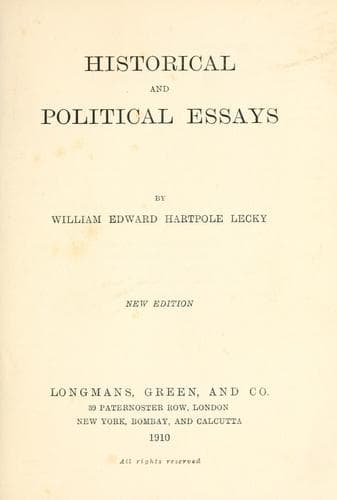
Historical and Political EssaysLecky, William Edward Hartpole
History
Historical and Political Essays
Lecky, William Edward Hartpole
History; Political science
Different ages differ enormously in the severity of proof which they
exact, in the degree of accuracy which they attain. The credibility of
a statement also depends not only on the amount of its evidence, but
also on its own inherent probability. Everyone will feel that an
amount of testimony that would be quite sufficient to persuade him
that a butcher's boy had been seen driving along a highway is wholly
different from that which would be required to persuade him that a
ghost had been met there. The same rule applies to the history of the
past, and it is complicated by the great difference in different ages
of the measure of probability, or, in other words, by the strong
predisposition in certain stages of knowledge to accept statements or
explanations of facts which in later stages we know to be incredible
or in a high degree improbable. Few subjects in history are more
difficult than the laws of evidence in dealing with the supernatural
and the extent to which the authority of historians in relating
credible and probable facts is invalidated by the presence of a
mythical element in their narratives.
Connected with this subject is also the question how far it is
possible by merely internal evidence to decompose an ancient document,
resolving it into its separate elements, distinguishing its different
dates and its different degrees of credibility. The reader is no doubt
aware with what a rare skill this method of inquiry has been pursued
in the present century, chiefly by great German and Dutch scholars, in
dealing with the early Jewish writings. At the same time, without
disputing the value of their work or the importance of many of the
results at which they have arrived, I may be pardoned for expressing
my belief that this kind of investigation is often pursued with an
exaggerated confidence. Plausible conjecture is too frequently
mistaken for positive proof. Undue significance is attached to what
may be mere casual coincidences, and a minuteness of accuracy is
professed in discriminating between the different elements in a
narrative which cannot be attained by mere internal evidence. In all
writings, but especially in the writings of an age when criticism was
unknown, there will be repetitions, contradictions, inconsistencies
and diversities of style which do not necessarily indicate different
authorship or dates.
Public-domain text, read in full here on John Shaqi.
Reviews
Reviews
No reviews yet
Be the first to share your thoughts on this work.
Join the Discussion
Join the discussion
Sign in to leave a comment or review.
Sign InorCreate an account