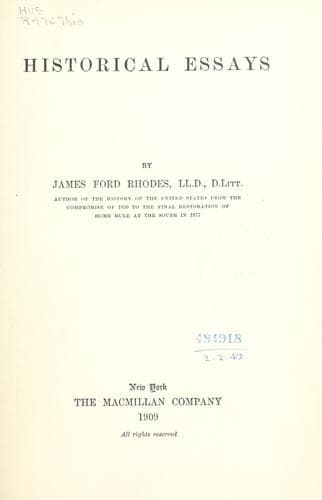
Great Britain -- History; History; United States -- History
It is related of Macaulay somewhere in his "Life and Letters," that in a
moment of despair, when he instituted a comparison between his
manuscript and the work of Thucydides, he thought of throwing his into
the fire. I suspect that Macaulay had not the knack of discarding
material on which he had spent time and effort, seeing how easily such
events glowed under his graphic pen. This is one reason why he is prolix
in the last three volumes. The first two, which begin with the famous
introductory chapter and continue the story through the revolution of
1688 to the accession of William and Mary, seem to me models of
historical composition so far as arrangement, orderly method, and
liveliness of narration go. Another defect of Macaulay is that, while he
was an omnivorous reader and had a prodigious memory, he was not given
to long-continued and profound reflection. He read and rehearsed his
reading in memory, but he did not give himself to "deep, abstract
meditation" and did not surrender himself to "the fruitful leisures of
the spirit." Take this instance of Macaulay's account of a journey: "The
express train reached Hollyhead about 7 in the evening. I read between
London and Bangor the lives of the emperors from Maximin to Carinus,
inclusive, in the Augustine history, and was greatly amused and
interested." On board the steamer: "I put on my greatcoat and sat on
deck during the whole voyage. As I could not read, I used an excellent
substitute for reading. I went through 'Paradise Lost' in my head. I
could still repeat half of it, and that the best half. I really never
enjoyed it so much." In Dublin: "The rain was so heavy that I was forced
to come back in a covered car. While in this detestable vehicle I looked
rapidly through the correspondence between Pliny and Trajan and thought
that Trajan made a most creditable figure." It may be that Macaulay did
not always digest his knowledge well. Yet in reading his "Life and
Letters" you know that you are in company with a man who read many
books and you give faith to Thackeray's remark, "Macaulay reads twenty
books to write a sentence; he travels a hundred miles to make a line of
description." It is a matter of regret that the progress of historical
criticism and the scientific teaching of history have had the tendency
to drive Macaulay out of the fashion with students, and I know not
whether the good we used to get out of him thirty-five years ago can now
be got from other sources. For I seem to miss something that we
historical students had a generation ago--and that is enthusiasm for the
subject. The enthusiasm that we had then had--the desire to compass all
knowledge, the wish to gather the fruits of learning and lay them
devoutly at the feet of our chosen muse--this enthusiasm we owed to
Macaulay and to Buckle. Quite properly, no one reads Buckle now, and I
cannot gainsay what John Morley said of Macaulay: "Macaulay seeks truth,
Public-domain text, read in full here on John Shaqi.
Reviews
Reviews
No reviews yet
Be the first to share your thoughts on this work.
Join the Discussion
Join the discussion
Sign in to leave a comment or review.
Sign InorCreate an account