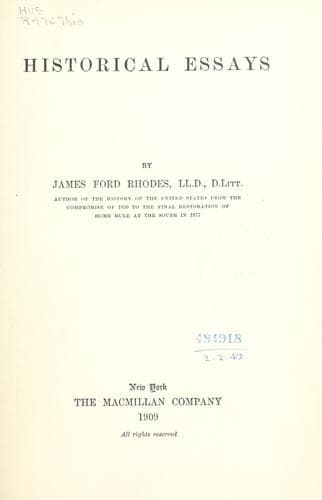
Great Britain -- History; History; United States -- History
We may also concede that, in the realm of intellectual endeavor, the
natural and physical sciences should have the precedence of history. The
present is more important than the past, and those sciences which
contribute to our comfort, place within the reach of the laborer and
mechanic as common necessaries what would have been the highest luxury
to the Roman emperor or to the king of the Middle Ages, contribute to
health and the preservation of life, and by the development of railroads
make possible such a gathering as this,--these sciences, we cheerfully
admit, outrank our modest enterprise, which, in the words of Herodotus,
is "to preserve from decay the remembrance of what men have done." It
may be true, as a geologist once said, in extolling his study at the
expense of the humanities, "Rocks do not lie, although men do;" yet, on
the other hand, the historic sense, which during our century has
diffused itself widely, has invaded the domain of physical science. If
you are unfortunate enough to be ill, and consult a doctor, he
expatiates on the history of your disease. It was once my duty to attend
the Commencement exercises of a technical school, when one of the
graduates had a thesis on bridges. As he began by telling how they were
built in Julius Caesar's time, and tracing at some length the development
of the art during the period of the material prosperity of the Roman
Empire, he had little time and space left to consider their construction
at the present day. One of the most brilliant surgeons I ever knew, the
originator of a number of important surgical methods, who, being
physician as well, was remarkable in his expedients for saving life when
called to counsel in grave and apparently hopeless cases, desired to
write a book embodying his discoveries and devices, but said that the
feeling was strong within him that he must begin his work with an
account of medicine in Egypt, and trace its development down to our own
time. As he was a busy man in his profession, he lacked the leisure to
make the preliminary historical study, and his book was never written.
Men of affairs, who, taking "the present time by the top," are looked
upon as devoted to the physical and mechanical sciences, continually pay
tribute to our art. President Garfield, on his deathbed, asked one of
his most trusted Cabinet advisers, in words that become pathetic as one
thinks of the opportunities destroyed by the assassin's bullet, "Shall I
live in history?" A clever politician, who knew more of ward meetings,
caucuses, and the machinery of conventions than he did of history
books, and who was earnest for the renomination of President Arthur in
1884, said to me, in the way of clinching his argument, "That
administration will live in history." So it was, according to Amyot, in
the olden time. "Whensoever," he wrote, "the right sage and virtuous
Emperor of Rome, Alexander Severus, was to consult of any matter of
Public-domain text, read in full here on John Shaqi.
Reviews
Reviews
No reviews yet
Be the first to share your thoughts on this work.
Join the Discussion
Join the discussion
Sign in to leave a comment or review.
Sign InorCreate an account