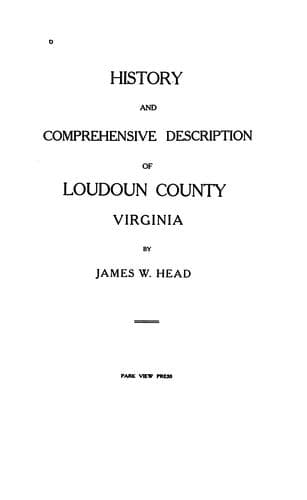
History and Comprehensive Description of Loudoun County, VirginiaHead, James William
History
History and Comprehensive Description of Loudoun County, Virginia
Head, James William
Loudoun County (Va.) -- History
The Catoctin Belt itself may be described as a broad area of igneous
rocks bordered by two lines of Lower Cambrian sandstones and slates.
Over the surface of the igneous rocks are scattered occasional
outliers of the Lower Cambrian slate; but far the greater part of the
surface of the belt is covered by the igneous rocks. The belt as a
whole may be regarded as an anticline, the igneous rocks constituting
the core, the Lower Cambrian the flanks, and the Silurian and Newark
the adjoining zones. The outcrops of the Lower Cambrian rocks are in
synclines, as a rule, and are complicated by many faults. The igneous
rocks have also been much folded and crumpled, but on account of their
lack of distinctive beds the details of folds can not well be traced
among them.
They are the oldest rocks in the Catoctin Belt and occupy most of its
area. They are also prominent from their unusual character and rarity.
An important class of rocks occurring in the Catoctin Belt is the
sedimentary series. It is all included in the Cambrian period and
consists of limestone, shale, sandstone and conglomerate. The two
border zones of the Catoctin Belt, however, contain also rocks of the
Silurian and Juratrias periods. In general, the sediments are sandy
and calcareous in the Juratrias area, and sandy in the Catoctin Belt.
They have been the theme of considerable literature, owing to their
great extent and prominence in the topography.
_Granite._
The granite in the southern portion of the County is very important in
point of extent, almost as much so as the diabase in the same section.
The areas of granite are, as a rule, long narrow belts, and vary
greatly in width.
The mineralogical composition of the granite is quite constant over
large areas. Six varieties can be distinguished, however, each with a
considerable areal extent. The essential constituents are quartz,
orthoclase and plagioclase, and by the addition to these of biotite,
garnet, epidote, blue quartz, and hornblende, five types are formed.
All these types are holocrystalline, and range in texture from coarse
granite with augen an inch long down to a fine epidote granite with
scarcely visible crystals.
_Loudoun Formation._
Public-domain text, read in full here on John Shaqi.
Reviews
Reviews
No reviews yet
Be the first to share your thoughts on this work.
Join the Discussion
Join the discussion
Sign in to leave a comment or review.
Sign InorCreate an account