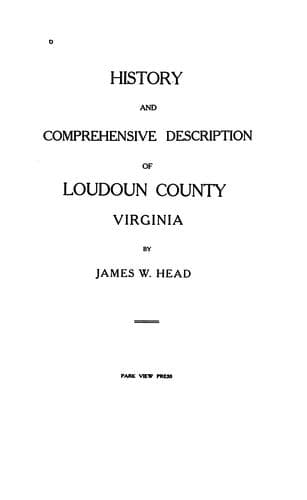
History and Comprehensive Description of Loudoun County, Virginia — John Shaqi
History and Comprehensive Description of Loudoun County, VirginiaHead, James William
History
History and Comprehensive Description of Loudoun County, Virginia
Head, James William
Loudoun County (Va.) -- History
The result of weathering upon the conglomerate is a very uneven and
rugged series of outcrops projecting above the rolling surface of the
soil.
The ledges show little definite stratification and very little dip.
The topography of the conglomerate is inconspicuous and consists of a
slightly rolling valley without particular features. It approaches
nearer to the level of the present drainage than any other formation,
and decay by solution has gone on to a very considerable extent. Where
the draining streams have approached their baselevel, scarcely an
outcrop of conglomerate is seen. Where the areas of conglomerate lie
near faster falling streams, the irregular masses of unweathered rocks
appear.
When but slightly weathered the conglomerate forms an effective
decorative stone and has been extensively used as a marble with the
name "Potomac marble," from the quarries on the Potomac east of Point
of Rocks, Maryland. While it is in no sense a marble, yet the
different reds and browns produced by unequal weathering of the
limestone pebbles have a very beautiful effect.
The thickness of the Newark formation is most uncertain. The rocks dip
at a light angle to the west with hardly an exception, and the
sections all appear to be continuous. Even with liberal deductions for
frequent faults, nothing less than 3,000 feet will account for the
observed areas and dips.
_Newark Diabase._
Description of the lithified deposits would be far from complete
without reference to the later diabase which is associated with the
Newark rocks.
These diabases, as they will be called generically, are usually
composed of plagioclase feldspar, and diallage or augite; additional
and rarer minerals are quartz, olivine, hypersthene, magnetite,
ilmenite, and hornblende. Their structure is ophitic in the finer
varieties, and to some extent in the coarser kinds as well. They are
holocrystalline in form and true glassy bases are rare, rendering the
term diabase more appropriate than basalt.
There is greater variety in texture, from fine aphanitic traps up to
coarse grained dolerites with feldspars one-third of an inch long. The
coarser varieties are easily quarried and are often used for building
stone under the name of granite.
These forms are retained to the present day with no material change
except that of immediate weathering, but to alterations of this kind
they are an easy prey, and yield the most characteristic forms. The
narrow dikes produce ridges between slight valleys of sandstone or
shale, the wide bodies produce broad flat hills or uplands. The rock
weathers into a fine gray and brown clay with numerous bowlders of
unaltered rock of a marked concentric shape.
Public-domain text, read in full here on John Shaqi.
Reviews
Reviews
No reviews yet
Be the first to share your thoughts on this work.
Join the Discussion
Join the discussion
Sign in to leave a comment or review.
Sign InorCreate an account