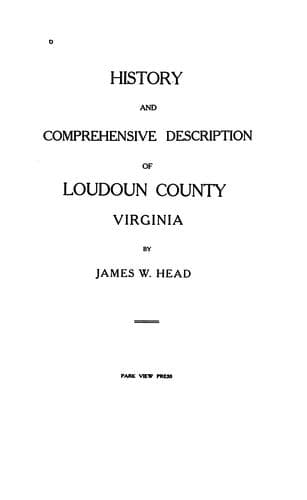
History and Comprehensive Description of Loudoun County, Virginia — John Shaqi
History and Comprehensive Description of Loudoun County, VirginiaHead, James William
History
History and Comprehensive Description of Loudoun County, Virginia
Head, James William
Loudoun County (Va.) -- History
The Cecil loam, owing to its rolling character, is well drained
throughout. Many small streams traverse it, affording ample outlets
for surface water. The gently rolling areas are not generally subject
to excessive erosion, but the steeper slopes wash badly, deep gullies
and ditches being formed on the hillsides. Especially subject to
erosion are the areas in which the subsoil contains a relatively large
proportion of mica fragments. The soil and subsoil, though quite
loamy, retain enough moisture in seasons of moderate rainfall to
supply all growing crops.
The Cecil loam is devoted entirely to general farming. The crops grown
are corn, wheat, grass, clover, vegetables, apples, and pears. The
agricultural interests are further diversified by the practice of
dairying and stock raising. The land is one of the best corn soils of
Loudoun, being loamy and easily cultivated throughout the growing
season. The average yield per acre ranges from 40 to 60 bushels. Wheat
does very well, producing from 12 to 20 bushels per acre, and more in
favorable seasons. Grass and clover yield at the rate of from 1 to 2
tons of hay per acre and form good grazing during a considerable part
of the year. Apples and pears are grown everywhere on the type,
usually in small orchards, and good yields of these fruits are
obtained. Oats were at one time grown, and can be produced at the rate
of from 35 to 50 bushels per acre, but the present acreage is small,
the farmers claiming that this crop rapidly reduces the productiveness
of the soil.
Nearly all of the type is in cultivated crops or pasture. The original
timber growth was oak, hickory, and walnut; but little of this stands
now, except on occasional woodlots. The Cecil loam is a soil which
with careful treatment makes a fine farming land; but carelessly
managed it very quickly deteriorates.
_Cecil Clay._
The soil of the Cecil clay consists of a heavy loam, red or brown in
color, and having an average depth of 8 inches. The subsoil generally
consists of a red clay, although it is sometimes a heavy clay loam.
The surface is generally free from stones, though occasional small
areas have a few quartz and granite or schist fragments. In the
Piedmont areas small rounded diabase fragments occur on the surface.
Occasionally on steep slopes or high knobs the soil covering has been
washed away, leaving the heavy red clay exposed on the surface. These
areas, however, are small.
The type occurs principally in the intermediate valley of the Catoctin
Belt, between the Blue Ridge and the Catoctin Mountain, and on the
west slopes of the Catoctin Mountain. In the valley it occupies
several small, disconnected areas scattered throughout this region,
while on the west slope of the mountain it is found in one of two
long, broad areas, extending in a northeast and southwest direction.
Three small areas occur near the southeastern corner of the County,
and the type is here closely related to the Iredell clay loam.
Public-domain text, read in full here on John Shaqi.
Reviews
Reviews
No reviews yet
Be the first to share your thoughts on this work.
Join the Discussion
Join the discussion
Sign in to leave a comment or review.
Sign InorCreate an account