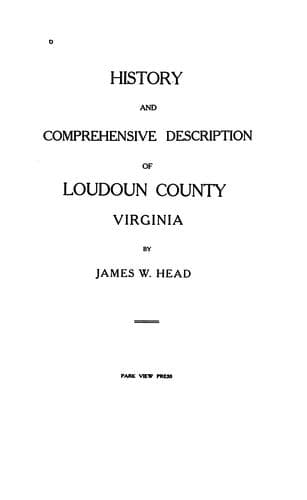
History and Comprehensive Description of Loudoun County, Virginia — John Shaqi
History and Comprehensive Description of Loudoun County, VirginiaHead, James William
History
History and Comprehensive Description of Loudoun County, Virginia
Head, James William
Loudoun County (Va.) -- History
The most typical areas of this soil occur in the Piedmont Plateau and
on the gentle slopes at the foot of the Blue Ridge in the vicinity of
Bluemont.
This soil type has excellent surface drainage and is well watered and
drained throughout by small streams. Few of the slopes are so steep as
to wash badly. The heavy clay subsoil retains ample moisture for plant
growth and the soil is rarely so wet as to necessitate tile draining,
although this would undoubtedly be very beneficial in the case of the
heavier phases.
The whole of this soil is under cultivation and it is highly esteemed
wherever found, being naturally a strong soil and susceptible of
improvement. The original forest growth consisted of oak, hickory, and
walnut. The land is easily improved, retentive of moisture and manure,
and with careful management makes an excellent soil for general
farming. Owing to its tendency to bake, crops are liable to suffer
during drought.
The land produces wheat, corn, grass, clover, apples, and pears. It is
a strong wheat soil, and yields from 15 to 25 bushels per acre and
occasionally more. Grass and clover hay yield at the rate of 1-1/2 to
2-1/2 tons per acre, while from 40 to 60 bushels of corn per acre are
usually produced in good seasons.
All things considered, the Cecil clay is best adapted to the
production of wheat and grass. The more loamy phases are adapted to
corn, but the type as a whole is a much better wheat land than corn
land. The soil is also well adapted to apples and pears. Bluegrass
grows well and makes fine pasturage, and stock raising and dairy
farming are other industries to which the Cecil clay is well suited.
Care has to be used in the cultivation of this soil, for if worked
when too wet it dries in large, hard clods that give trouble
throughout the season and interfere with cultivation for a long time
afterwards.
_Cecil Silt Loam._
The surface soil of the Cecil silt loam consists of 12 inches of a
light gray or white silt loam. This material is underlain by a subsoil
of yellow silt loam slightly heavier than the soil. The type is
locally termed "white land," and is closely related to the Penn loam
and the Iredell clay loam, these types surrounding and grading
gradually into it. In some areas the soil is quite free from stones,
while in others from 10 to 30 per cent of the soil mass is composed of
small rock fragments.
The type occupies several small areas in the Piedmont region, in the
southeastern part of the County. The largest of these areas lies about
2 miles east of Leesburg, and a considerable part of the type is
adjacent to the Potomac River. It occupies high, rolling, ridgy, or
hilly lands, and has some rather steep slopes, though in general the
surface is only gently sloping.
The drainage is good, but wherever the slopes are steep erosion
proceeds rapidly, making gullies and washed-out places that hinder or
entirely prevent cultivation. The type is well watered by small
streams which flow the year round.
Public-domain text, read in full here on John Shaqi.
Reviews
Reviews
No reviews yet
Be the first to share your thoughts on this work.
Join the Discussion
Join the discussion
Sign in to leave a comment or review.
Sign InorCreate an account