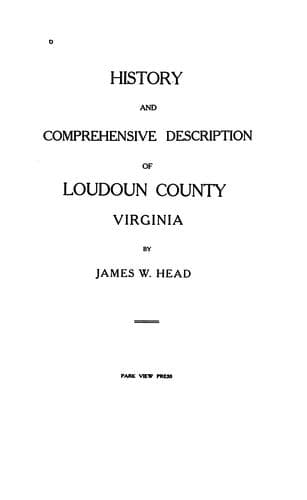
History and Comprehensive Description of Loudoun County, VirginiaHead, James William
History
History and Comprehensive Description of Loudoun County, Virginia
Head, James William
Loudoun County (Va.) -- History
Probably one-half of this type is cultivated. The remainder is
covered with a growth of scrub oak, pine, and some cedar. The soil is
thin and only fairly productive, and consequently is not greatly
desired for agriculture. It is very easy to work, but has to be
cultivated carefully to avoid washing. The crops raised are corn,
wheat, grass, and some apples. Corn yields from 25 to 35 bushels,
wheat from 12 to 15 bushels, and clover and timothy hay from 1 to 2
tons per acre. Small fruits and vegetables do well.
Although naturally a thin soil, the Cecil silt loam is fairly well
adapted to the production of the crops just named. Of the small
fruits, peaches, plums, and berries do best. On the whole the type is
considered much better adapted to wheat than to corn. It is limed and
fertilized to a considerable extent, and responds well to such
applications.
_Cecil Mica Loam._
The Cecil mica loam consists of 12 inches of a friable, micaceous
yellow or yellowish red loam, underlain by a yellow or yellowish-red
loam, whose mica content increases with the depth until at 24 to 30
inches the subsoil is little more than a mass of small mica flakes
which gives it a loose texture. Occasionally the subsoil is a clay
loam for several inches before grading into the unweathered mica
particles.
On the surface there is from 5 to 40 per cent of angular quartz
fragments, ranging from 1 to 6 inches in diameter, some being much
larger.
The Cecil mica loam occurs as one long, narrow strip, occupying the
lower, gentle eastern slopes of the Catoctin Mountain. The southern
end of the strip begins a short distance north of Leesburg, and
extends in a northeasterly direction to the Potomac River, opposite
Point of Rocks, Md.
The topographic features of the Cecil mica loam consist of gentle and
occasionally steep rolling slopes. The surface is well drained and on
the steeper slopes the soil washes badly and deep gullies are formed.
In a season of moderate rainfall the soil and subsoil retain
considerable moisture, but in dry weather crops suffer from drought.
No farms are found entirely on the Cecil mica loam, but those farms of
the Piedmont, extending up the mountain slopes, generally include some
of this soil. Such areas are often farmed, but more generally used as
woodlots. Where cultivated the yields are scant, except where the soil
is heavily fertilized. Corn yields from 10 to 30 bushels per acre and
sometimes more, and wheat from 6 to 12 bushels per acre. The type is
best adapted to forestry, chestnut orcharding, and grape growing.
_De Kalb Stony Loam._
Public-domain text, read in full here on John Shaqi.
Reviews
Reviews
No reviews yet
Be the first to share your thoughts on this work.
Join the Discussion
Join the discussion
Sign in to leave a comment or review.
Sign InorCreate an account