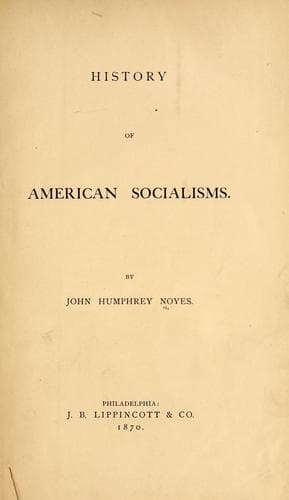
History of American SocialismsNoyes, John Humphrey
History
History of American Socialisms
Noyes, John Humphrey
Communism -- United States; Socialism -- United States
"Their system of labor and pay was somewhat complicated, and
never could be satisfactorily arranged. The farmers and
mechanics were always jealous of each other, and could not be
brought to feel near enough to work on and divide the profits at
the end of the year; but as they ever hoped to get over this
difficulty, they said but very little about it. In their system
of labor they formed groups for each kind of work; each group,
when consisting of three or more, choosing its own foreman, who
kept the account of the time worked by each member, and reported
weekly to a meeting of all the members, which regulated the
average; and then the Secretary copied it; and at the end of the
fiscal year each person drew, on his labor account, his
proportion of the three-fourths of the increase and products
which was allotted to labor, and on his stock shares, his
proportion of the one-fourth that was divided to stock. The
amount so divided was ascertained by an annual appraisal of all
the property, thus ascertaining the rise or increase in value,
as well as the product of labor. The dividend to capital was,
however, usually considered too large and disproportionate.
"The books and accounts were accurately kept by the Secretary,
and most of the individual transactions passed through this
form, thus leaving all accounts in the hands of a disinterested
person, open to inspection at all times, and bringing about an
annual settlement which avoided many difficulties incident to
civilization.
"The table of the Community, when kept as a public
boarding-house, where the families and visitors or travelers
were mostly seated, was set with plain but substantial food,
much like the tables of farmers in newly settled agricultural
States; but it often incurred the ridicule of loafers and
epicures, who travel much and fare better with strangers than at
home.
"They had among their number a few men of leading intellect who
always doubted the success of the experiment, and hence
determined to accumulate property individually by any and every
means called fair in competitive society. These would
occasionally gain some important positions in the society, and
representing it in part at home and abroad, caused much trouble.
By some they were accounted the principal cause of the final
failure.
Public-domain text, read in full here on John Shaqi.
Reviews
Reviews
No reviews yet
Be the first to share your thoughts on this work.
Elsewhere in the archive
Join the Discussion
Join the discussion
Sign in to leave a comment or review.
Sign InorCreate an account