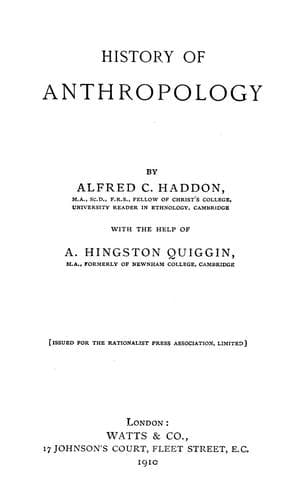
History of anthropologyHaddon, Alfred C. (Alfred Cort)
History
History of anthropology
Haddon, Alfred C. (Alfred Cort)
Anthropology -- History
Not only was Aristotle (384-322 B.C.) the first authority to make use of
the word “anthropology,”[10] but he may also be described as an
anthropologist. Material had been collected by travellers, such as
Hanno, the Carthaginian, who encountered gorillas in Africa; by
historians, such as Herodotus (who was also a traveller); and by
doctors, such as Hippocrates. Aristotle was indebted to some extent to
all of these; but his vast works in natural history were based mainly on
what he considered of primary importance—facts of actual personal
knowledge derived from personal observation. On this account alone his
writings deserved the place which they held for many centuries.
Footnote 10:
Cf. p. 6.
Thus, undisturbed by the dogmas of religion or philosophy, he placed man
naturally among the animals (being thus, as Topinard remarks, about
twenty centuries ahead of humanity), but distinguished from them by
certain features—by the relative size of the brain, by two-leggedness,
by mental characters, etc. Some writers regard it as improbable that
either Hippocrates or Aristotle had ever dissected the human body, but
it is also possible to hold an opposite view. Even Galen (c. 130 A.D.),
whose anatomy held the field for more than a thousand years, had to base
his conclusions on the bodies of animals, notably on those of monkeys;
and, although he did not conceal the fact, it was not until the time of
Vesalius that the discrepancy between simian and human anatomy was
discovered.
[Sidenote: =Vesalius.=]
Vesalius (1513-1564) is the next great name in the history of physical
anthropology. He was Professor of Anatomy at Padua, Bologna, and Pisa,
and physician to Charles V. and Philip II. His work marks a revolution
in anatomical science; for not only did he overthrow the doctrines which
had been accepted for fourteen centuries, demonstrating that to a great
extent Galen had studied the anatomy of the ape rather than that of man,
but, by his own deductions from direct observation and original
research, he established a fresh and unassailable foundation for future
investigation. His services to anatomy have been compared to those of
Galileo and Copernicus in the field of astronomy. His fate was not
unlike that of many other daring pioneers of the Middle Ages. He was
accused of having dissected a man while yet alive, and was dragged by
his enemies before the Inquisition and condemned to death. By the
intercession of the king his sentence was commuted into a pilgrimage to
the Holy Sepulchre; but on his return journey he was shipwrecked and
drowned off the island of Zante.
Cunningham, in his Presidential Address to the Royal Anthropological
Institute, 1908, refers to the work of Vesalius, whom he describes as
one of the most remarkable figures in the sixteenth century. He adds:—
Public-domain text, read in full here on John Shaqi.
Reviews
Reviews
No reviews yet
Be the first to share your thoughts on this work.
Join the Discussion
Join the discussion
Sign in to leave a comment or review.
Sign InorCreate an account