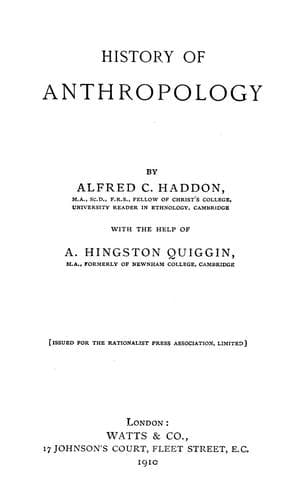
History of anthropologyHaddon, Alfred C. (Alfred Cort)
History
History of anthropology
Haddon, Alfred C. (Alfred Cort)
Anthropology -- History
The word “caste” is of Portuguese origin. In the 179th hymn of the first
Mandala of the Rig-Veda, as Dr. Gerson da Cunha points out,[8] the word
_varna_ is used in the dual number, _ubhau varnau_, “two colours,” white
of the Aryans and black of the Dasyus—that is, of the “Dravidian”
aborigines, who are elsewhere called “black-skinned,” “unholy,”
“excommunicated.” Other texts dwell on their low stature, coarse
features, and their voracious appetite. The Rig-Veda employs the word
_anâsa_—“noseless”—to characterise the Dasyus and Daityas, which
designations mean “thieves” or “demons.” It is hardly an exaggeration to
say that from these sources there might be compiled a fairly accurate
anthropological definition of the jungle tribes of to-day.
Footnote 8:
“Presidential Address: The Nasal Index in Biological Anthropology,”
_Journ. Anth. Soc. of Bombay_, 1892, p. 542.
Thus were the foundations of descriptive anthropology unconsciously
laid.
In our own day racial characters are seized upon in the same manner, and
racial antipathy adds fuel to its own fire in regarding traits which
differ from those of the speaker or writer as being ugly, objectionable,
or of low type. “The study of race,” said the late Sir William Flower
(1831-1899), “is at a low ebb indeed when we hear the same contemptuous
epithet of ‘nigger’ applied indiscriminately by the English abroad to
the blacks of the West Coast of Africa, to Kafirs of Natal, the Lascars
of Bombay, the Hindoos of Calcutta, the aborigines of Australia, and
even the Maories of New Zealand.”[9] The Englishman who contemns as a
“nigger” any dark-skinned native has not advanced in race discrimination
beyond his remote kinsman who crossed into the valley of the Indus some
four thousand years ago.
Footnote 9:
_Report Brit. Assoc._, 1881, p. 683.
[Sidenote: =Hippocrates.=]
Hippocrates (460-357 B.C.), “the Father of Physic,” was certainly a
pioneer in physical anthropology. He says: “I will pass over the smaller
differences among nations, but will now treat of such as are great
either from nature or custom; and, first, concerning the macrocephali.
There is no other race of men which have heads in the least resembling
theirs.” He believed that this elongated conformation of the head was
originally produced artificially; but subsequently it was inherited, or,
as he puts it: “Thus, at first usage operated, so that this constitution
was the result of force; but in the course of time it was formed
naturally, so that usage had nothing to do with it”—a view adopted many
centuries later by Buffon and others.
[Sidenote: =Aristotle.=]
Public-domain text, read in full here on John Shaqi.
Reviews
Reviews
No reviews yet
Be the first to share your thoughts on this work.
Join the Discussion
Join the discussion
Sign in to leave a comment or review.
Sign InorCreate an account