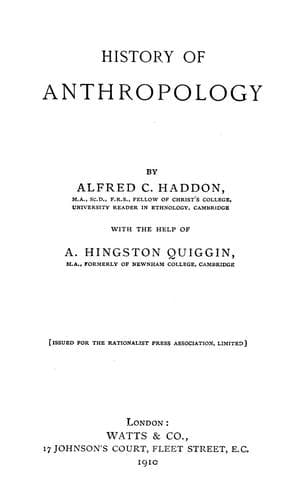
History of anthropologyHaddon, Alfred C. (Alfred Cort)
History
History of anthropology
Haddon, Alfred C. (Alfred Cort)
Anthropology -- History
This theory is mainly associated with the name of de Quatrefages
(1810-1892). In the Introduction to his book on the pygmies he says:
“For a long time past the small black races have attracted my attention
and my interest in a special manner.” His earliest investigations of the
subject were published in 1862, and continued until 1887. Analysing the
evidence, he shows that the two localities where the ancients appear to
place their pygmies (the interior of Africa and the southern-most parts
of Asia), together with the characters assigned to them, indicate an
actual knowledge of the two groups of small people (Negrilloes and
Negritoes), who are still to be found in those regions. Professor J.
Kollmann, of Basel, in his _Pygmäen in Europa_ (1894), argues for the
existence of a European pygmy race in Neolithic times from some remains
found at Schaffhausen, and the wide prevalence of short statures among
many peoples in Europe, especially in the south. Mr. David MacRitchie
attributes not only legends of pygmies, but fairy-tales in general, to
this prehistoric dwarf race. President Windle sums up the question
thus:—
It is possible with more or less accuracy and certainty to
identify most of those races which, described by the older
writers, had been rejected by their successors. Time has brought
their revenge to Aristotle and Pliny by showing that they were
right, where Tyson, and even Buffon, were wrong. (P. liii.)
In the time of Aristotle Man took his place naturally at the head of the
other animals, being distinguished from the brutes by certain
characters. But the influence of religion and of philosophy did not long
permit of this association. Man came to be regarded as the _chef
d’œuvre_ of creation, a thing apart, a position aptly described in the
words of Saint Paul (marginal version) “for a little while inferior to
the angels.”
In the eighteenth century came a startling change. Man was wrenched from
this detached and isolated attitude, and linked on once more to the
beasts of the field. This was the work of Linnæus.
[Sidenote: =Linnæus.=]
The year 1707 is memorable in the history of Anthropology as the date of
the birth of two of its greatest men, Linnæus[12] (1707-1778) and Buffon
(1707-1788). Both devoted long lives to science, and both produced
monumental works of permanent value; but it would be hard to find two
contemporary figures engaged in the same pursuit whose lives presented a
greater contrast.
Footnote 12:
By a patent of nobility conferred in 1757 Linnæus became Karl von
Linné.
Public-domain text, read in full here on John Shaqi.
Reviews
Reviews
No reviews yet
Be the first to share your thoughts on this work.
Join the Discussion
Join the discussion
Sign in to leave a comment or review.
Sign InorCreate an account