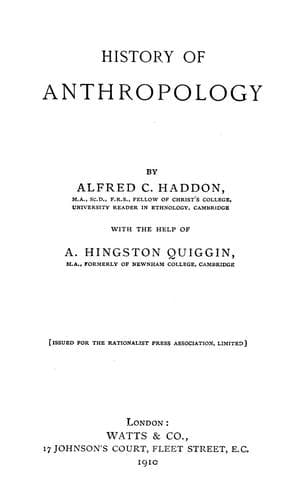
History of anthropologyHaddon, Alfred C. (Alfred Cort)
History
History of anthropology
Haddon, Alfred C. (Alfred Cort)
Anthropology -- History
Linnæus was the son of a poor pastor, and his mother was the daughter of
the former pastor of the same small Swedish parish. At the early age of
four young Karl is said to have taken an interest in botany, and to have
begun to ask questions that his father could not answer. Either to
escape this interrogation, or for wiser motives, the father made it a
rule never to answer the same question twice, and to this early
discipline Linnæus used to trace his tenacious memory. The boy was
intended for the ministry, and was early sent to school; but, as he
devoted all his time to botany, his progress in theology was _nil_, and
when, after two years, his father visited the school, and learnt of the
disappointing result of all the pinching and saving which had gone to
provide for the son’s education, he resolved to apprentice him to a
tailor or shoemaker in hopes of obtaining a better return for his
outlay. Fortunately a friend intervened, and gave the boy board and
lodging, besides private tuition, while he finished his gymnasium
course. His work as a student seems to have failed to satisfy his
instructors, for when he proceeded to the University of Lund it was with
the enigmatic testimonial to the effect that “some shrubs in a garden
may disappoint the cares of the gardener, but if transplanted into
different soil may prosper.”
When barely twenty-two he left Lund for Upsala, taking with him his
entire fortune of £8, and, being inexperienced and unknown, soon found
himself in desperate straits. He was rescued by the generosity of Dr.
Celsius, a professor of theology, but student of botany, who, impressed
with Karl’s collections and enthusiasm, offered him board and lodging,
and obtained for him some private pupils. The hardships of his life were
not yet over, but gradually his work obtained recognition, abroad sooner
than at home, and he could have lived at his ease in England or the
Netherlands; only (as he expressed it), “his Sara was in Sweden,” and he
returned to his native land to scrape together sufficient means to marry
her.
[Sidenote: =Buffon.=]
From the beginning Georges Louis Leclerc, Comte de Buffon, was marked
out for a different life. His father was a Burgundian Councillor, and
his mother, besides being an heiress, was a woman of unusual ability. He
was originally destined for the law, but his tastes always inclined
towards science, and he soon found occasion to follow them.
He made the acquaintance of a young Englishman of rank and of his tutor,
who was a man of science, and with them he travelled on the continent.
About the same time Linnæus was also travelling, but in a different
fashion. He set out to make explorations in Lapland, then very little
known, carrying his luggage on his back, and covered nearly 5,000 miles
at a cost of about £25. During his travels he kept a diary[13] of his
observations, which contains not only botanical but also ethnological
information of great value.
Footnote 13:
Public-domain text, read in full here on John Shaqi.
Reviews
Reviews
No reviews yet
Be the first to share your thoughts on this work.
Join the Discussion
Join the discussion
Sign in to leave a comment or review.
Sign InorCreate an account