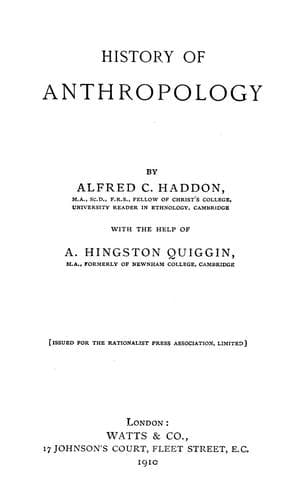
History of anthropologyHaddon, Alfred C. (Alfred Cort)
History
History of anthropology
Haddon, Alfred C. (Alfred Cort)
Anthropology -- History
Linnæus did not include these in his _Homo Monstrosus_; but various
questionable creatures are inserted by his pupil Hoppius in the treatise
_Anthropomorpha of Linnæus_, read in 1760.[17] Such were the _Satyr_ of
Vulpius, who, “when it went to bed, put its head on the pillow, and
covered its shoulders with the counterpane, and lay quite quiet like a
respectable woman”; _Lucifer_ (_Homo caudatus_), the “dreadful foul
animals—running about like cats,” who rowed in boats, attacked and
killed a boatload of adventurers, cooking and eating their bodies; and
the _Troglodyta_ (_Homo nocturnus_), who in the East Indies “are caught
and made use of in houses as servants to do the lighter domestic work—as
to carry water, lay the table, and take away the plates.” But all these
were classed among the _Simiæ_. Within the species _Homo sapiens_
Linnæus included wild or natural man, _Homo sapiens ferus_, whose
existence was widely believed in at the time. The most authentic case
was that of “Wild Peter,” the naked brown boy discovered in 1724 in
Hanover. He could not speak, and showed savage and brutish habits and
only a feeble degree of intelligence. He was sent to London, and, under
the charge of Dr. Arbuthnot, became a noted personage, and the subject
of keen discussion among philosophers and naturalists. One of his
admirers, more enthusiastic than the others, declared that his discovery
was more important than that of Uranus, or the discovery of thirty
thousand new stars.
Footnote 17:
Bendyshe, p. 447.
Blumenbach alone, apparently, took the trouble to investigate the origin
of Wild Peter, and in the article he wrote on the subject disposed for
all time of the belief in the existence of “natural man.” He pointed out
that when Peter was first met he wore fastened round his neck the torn
fragments of a shirt, and that the whiteness of his thighs, as compared
with the brown of his legs, showed that he had been wearing breeches and
no stockings. He finally proved that Peter was the dumb child of a
widower, who had been thrust out of his home by a new step-mother.[18]
Footnote 18:
Cunningham, pp. 24-5.
------------------------------------------------------------------------
CHAPTER II.
THE SYSTEMATISERS OF PHYSICAL ANTHROPOLOGY
HITHERTO we have been dealing with the great pioneers in Anthropology,
those who laid the foundations, brought order out of chaos, and
suggested the outlines of future work. Henceforward Anthropology may
claim the name of a science, and the work developed on definite lines.
It will be more convenient to treat these separately, abandoning a
strict chronological method.
Public-domain text, read in full here on John Shaqi.
Reviews
Reviews
No reviews yet
Be the first to share your thoughts on this work.
Join the Discussion
Join the discussion
Sign in to leave a comment or review.
Sign InorCreate an account