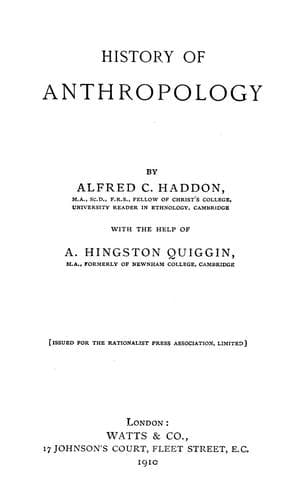
History of anthropologyHaddon, Alfred C. (Alfred Cort)
History
History of anthropology
Haddon, Alfred C. (Alfred Cort)
Anthropology -- History
In Germany the greatest name is that of Virchow. Rudolf Ludwig Karl
Virchow (1821-1902) had already gained fame in the medical world,
especially with regard to histology, pathology, and the study of
epidemics, and was the prime leader in the “_Medizinische Reform_”
movement before he began his valuable contributions to the science of
Anthropology.
His first anthropological writings were some papers on cretinism (1851
and 1852), and from this date onwards his services to the science can
scarcely be over-estimated. Much of his energy was also given to somatic
anthropology, and in 1866 he started his investigations into prehistoric
archæology, combining scientific method with spade-work.
In a notice of his work by Oscar Israel[27] (p. 656) we read:—
Footnote 27:
Smithsonian Report, 1902. Translated from the _Deutsche Rundschau_ of
Dec., 1902.
Virchow devoted himself to ethnographic studies no less than to
other branches of anthropology, and here he became a center to
which the material streamed from all sides, and from which went
forth suggestion, criticism, and energetic assistance. This
never-idle man did not disdain to teach travelers schooled in
other lines of investigation the anthropometric methods; and,
indeed, he found time for everything, and never left a piece of
work to others that he could possibly do himself. Thus, for
example, for ten years following its inception by him in 1876,
he worked up alone the data recorded in German schools as to the
color of the eyes, the hair, and the skin which has proved of
such value for the knowledge of the different branches of the
German race.
[Sidenote: =Sergi.=]
Professor Sergi at one time proposed to banish measurements from
craniology, and to rely solely on observational methods. He has later
modified his extreme position, while, as a result of his crusade, he has
induced most anthropologists to pay more attention to the configuration
of the skull, and some of his descriptive terms have come into common
use.
[Sidenote: =Hagen’s Criticism of Craniometry.=]
Dr. Hagen relates the extreme specialisation into which craniologists
were led:—
A rage for skull measurements, vast, vigorous, and heedless, set
in on all sides, especially after Lucae had discovered and
perfected a method of accurately representing the irregular form
of the object studied. “More skulls” was henceforth the war-cry;
the trunk, extremities, soft tissues, skin and hair, might all
go by the board, being counted of no scientific value whatever.
Anthropologists, or those who aspired to the title, measured and
delineated skulls; museums became veritable cities of skulls,
and the reputation of a scientific traveller almost stood or
fell with the number of crania which he brought back with him.
Public-domain text, read in full here on John Shaqi.
Reviews
Reviews
No reviews yet
Be the first to share your thoughts on this work.
Join the Discussion
Join the discussion
Sign in to leave a comment or review.
Sign InorCreate an account