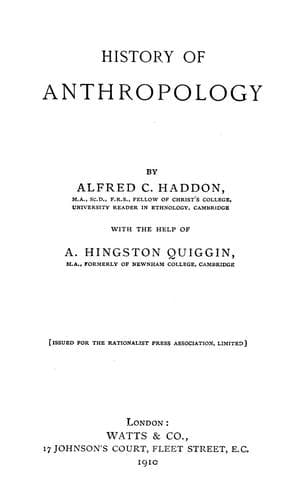
History of anthropologyHaddon, Alfred C. (Alfred Cort)
History
History of anthropology
Haddon, Alfred C. (Alfred Cort)
Anthropology -- History
After two decades of measuring and collecting ever greater
quantities of material from foreign lands, and from the
so-called primitive or aboriginal races, the inadequacy of
Retzius’s method became apparent. Far too many intermediate
forms were met with, which it was found absolutely impossible to
classify by its means. In accordance with the suggestion of the
French anthropologist Broca, and of Welcker, Professor of
Anatomy at Halle, a third type, the so-called Mesocephalic form,
was interposed between the two forms recognised by Retzius. Even
this did not suffice, however. In the face of the infinite
variety of form of the crania now massed together, a variety
only comparable to that of leaves in a forest, this primitively
simple scheme, with its four and finally six types, failed
through lack of elasticity. Then began complication extending
ever further and further. Attention was no longer confined to
the length and breadth, but also to the height of the cranium,
high and low (or flat) skulls—_i.e._, hypsicephalic and
chamaecephalic varieties being recognised. The facial part of
the skull was examined not only from the side, with a view to
recording the straightness or obliquity of the profile, but also
from the front; and there were thus distinguished long, medium,
and short faces, and also broad and narrow facial types. The
nasal skeleton, the palate, the orbit, the teeth, and the
mandible were investigated in turn, and at last all the
individual bones of the cranium and face, their irregularities
of outline, and their relations to one another, were subjected
to the closest examination and most subtle measurements, with
instruments of extreme delicacy of construction and ingenuity of
design, till, finally, the trifling number of five thousand
measurements for every skull found an advocate in the person of
the Hungarian Professor V. Török (whereby the wealth of detail
obscured the main objects of study); while, on the other hand,
observers deviated into scientific jugglery, like that of the
Italian Professor Sergi, who contrived to recognise within the
limits of a single small archipelago, the D’Entrecasteaux group
of islets near New Guinea, as many as eleven cranial varieties,
which were all distinguished by high-sounding descriptive names,
such as _Lophocephalus brachyclitometopus_, etc.
[Sidenote: =Macalister’s Criticism of Craniometry.=]
The misuse of Craniometry is also described by Professor Alexander
Macalister[28]:—
Footnote 28:
Presidential Address to Section H., Brit. Ass., 1892.
Public-domain text, read in full here on John Shaqi.
Reviews
Reviews
No reviews yet
Be the first to share your thoughts on this work.
Join the Discussion
Join the discussion
Sign in to leave a comment or review.
Sign InorCreate an account