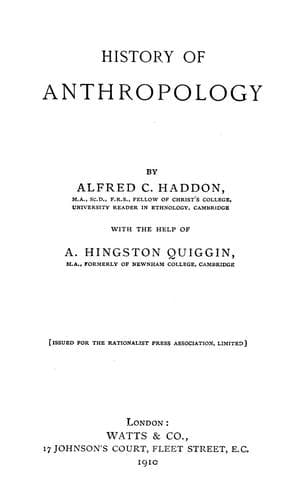
History of anthropologyHaddon, Alfred C. (Alfred Cort)
History
History of anthropology
Haddon, Alfred C. (Alfred Cort)
Anthropology -- History
Through the initiative of Sir Francis Galton, as Dr. Myers points out,
anthropometry has begun to investigate other problems which must
ultimately be of ethnological interest; and he has opened out the whole
subject of heredity, which eventually must enter into every branch of
physical anthropology. The followers of Mendel are at present laying a
foundation upon their experiments with plants and animals. At present
very little attention has been paid by them to man; nor, probably, can
much be attempted until more precise data are available.
Lamentably little is known with accuracy about the physical and
psychical effects of the mixture of different human types, and it is yet
to be determined how far the admitted unsatisfactory character of many
half-caste populations is due to physiological or sociological causes.
There is a great dearth of sufficiently numerous and reliable
observations and statistics concerning the effect of the environment
upon small or large groups of human beings—a problem to which Professor
Ridgeway devoted his last presidential address to the Royal
Anthropological Institute (1910).
It is often important that the physical fitness of people should be
tested, in order to see how they stand in relation to other people, and
to discover any physical imperfections. Especially is this desirable in
the case of children; and the government inspection of school children,
though inadequate, is a step in the right direction. By such means early
inclinations to various defects are discovered and prevented, and
valuable statistics are obtained which can not only be utilised for
comparative purposes, but may form a basis for future legislation. It is
also a matter of importance to determine whether certain imperfections
are due to diseased, abnormal, or other undesirable factors in their
parentage; or whether they are the results of unfavourable subsequent
conditions. But in order that comparisons can be made, it is necessary
to make similar investigations on the normal, capable, and healthy
population.
Another branch of investigation was undertaken mainly for the
identification of criminals, and consisted in certain measurements
selected by M. Alphonse Bertillon, supplemented by photographs and a
record of individual peculiarities. The practical value of this method
of identification in France was demonstrated by its immediate results.
Criminals began to leave off aliases, and numbers of them flocked to
England. Finger-prints as a means of identification were first
discovered by Purkenje, the Breslau physiologist (1823), who utilised
them for classification. Sir William Herschel, of the Indian Civil
Service, adopted the method in Bengal, and now methods introduced by Sir
Francis Galton are in use in India, England, and elsewhere, having in
most cases supplanted the Bertillon system.
------------------------------------------------------------------------
CHAPTER III.
Public-domain text, read in full here on John Shaqi.
Reviews
Reviews
No reviews yet
Be the first to share your thoughts on this work.
Join the Discussion
Join the discussion
Sign in to leave a comment or review.
Sign InorCreate an account