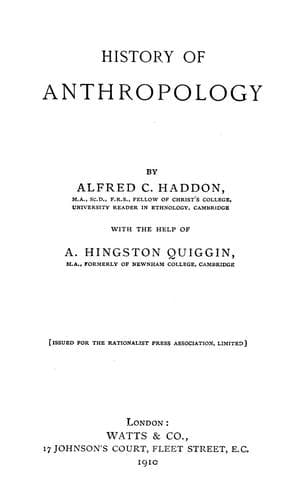
History of anthropologyHaddon, Alfred C. (Alfred Cort)
History
History of anthropology
Haddon, Alfred C. (Alfred Cort)
Anthropology -- History
Footnote 30:
C. S. Myers, “The Future of Anthropometry,” _Journ. Anth. Inst._,
xxxiii., 1903, p. 36.
Dr. Myers emphatically states:—
If physical anthropology is to be a science, its results _must_
be capable of expression in mathematical formulæ. To this end
some of the most interesting of biological work of the age is
tending ... generally speaking, the study of living forms is
passing from the descriptive to the quantitative aspect, and it
is by experiment and observation on biometrical lines that
future progress is clearly promised.... Thanks to the recent
work of Professor Karl Pearson, the proper start has at last
been made.
His school is now attacking by statistical methods the problem of the
dependence of the variation of one character upon that of another. It
should be remembered that Quetelet was the first to apply the Gaussian
Law of Error to human measurements in its elementary binomial form; in
this he was followed by Sir Francis Galton, who was the first in this
country to realise the importance of applying mathematical methods to
anthropological measurements and observations. An interesting account of
the genesis of his work in this direction is given in his _Memories of
My Life_ (1908). Similar work has also been undertaken by German
investigators.
[Sidenote: =Scientific and Practical Value of Anthropometry.=]
We may conclude this chapter with a brief summary of the main lines
which investigations are now taking; but it is impossible to mention
even the more important of recent workers in this vast field.
From the beginning of the study, anthropometry was employed as a precise
means of expressing the differences between man and the lower animals;
and, owing to improved methods of research and the discovery of new
material, the origin and differentiation of man is still investigated
with assiduity.
Though no one measurement can be used for purposes of race
discrimination, yet a series of measurements on a sufficiently large
group of subjects, together with observations on the colour of the skin,
hair, and eyes, the form of various organs—such as the nose and ears—and
other comparisons of a similar nature, are invaluable in the study of
the races of mankind. It is only in this way that the mixtures of the
population can be sorted out, their origins traced, and some idea gained
of the racial migrations which have taken place since man first
appeared.
Public-domain text, read in full here on John Shaqi.
Reviews
Reviews
No reviews yet
Be the first to share your thoughts on this work.
Join the Discussion
Join the discussion
Sign in to leave a comment or review.
Sign InorCreate an account