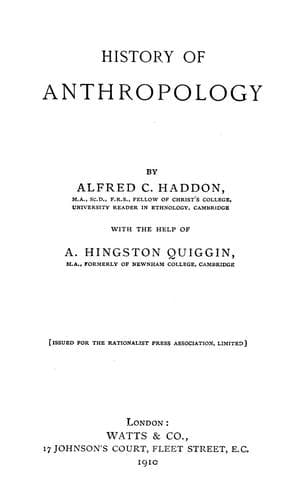
History of anthropologyHaddon, Alfred C. (Alfred Cort)
History
History of anthropology
Haddon, Alfred C. (Alfred Cort)
Anthropology -- History
The discovery of the New World dealt a severe blow to the authority of
the Fathers on matters of science. Antipodal man, whom St. Augustine[33]
had extinguished as “excessively absurd,” was found to exist, and the
Spaniards forthwith excused their barbarities to the American natives on
the plea that they were not the descendants of Adam and Eve.
Footnote 33:
_De Civitate Dei._
[Sidenote: =Polygenism and Monogenism.=]
Henceforward the polygenists began to gain ground. Theophrastus
Paracelsus (1520) first asserted the plurality of the races of mankind,
and explained the Mosaic cosmogony as having been written
“theologically—for the weaker brethren.” Vanini (1616) mentions a
belief, entertained by atheists, that man was descended from or allied
to monkeys. In 1655 Isaac de la Peyrère, a Calvinist scholar of
Bordeaux, published in Amsterdam his _Præ-Adamitæ_, to prove that Adam
and Eve were not the first human beings upon the earth; and his work,
being prohibited by authority, became immensely popular.
His theory, though unorthodox, was founded on Scripture, and regarded
Adam and Eve as merely a special and much later creation; the Gentiles,
who peopled the rest of the earth, having been formed from the dust of
the earth, together with the beasts of the field, on the sixth day. The
inhabitants of the New World, which, being separate from the Old, could
not have been peopled with the same race, were of Gentile origin. This
theory was bitterly opposed. The _Parlement_ of Paris caused the book to
be publicly burned. The Inquisition laid hands on the author, and he was
forced to abjure both his Pre-Adamite heresy and his Calvinism. He died
in a convent in 1676.
The writings of the Encyclopedists, the freedom of thought claimed by
Voltaire and Rousseau, together with the classification of species by
Linnæus, emboldened the polygenists. Lord Kames[34] was one of the
earliest exponents in England, and he soon found many followers. Two
separate lines of antagonism may be distinguished in the controversy. In
one—the Anglo-French—Prichard, Cuvier, and de Quatrefages represent the
monogenists, and Virey and Bory de Saint-Vincent the polygenists; the
other, in which America and the slavery question were implicated,
polygenists and anti-abolitionists going hand-in-hand, was represented
by Nott and Gliddon in America, Knox and Hunt in England, and Broca in
France.
Footnote 34:
_Sketches on the History of Man_, 1774.
Public-domain text, read in full here on John Shaqi.
Reviews
Reviews
No reviews yet
Be the first to share your thoughts on this work.
Join the Discussion
Join the discussion
Sign in to leave a comment or review.
Sign InorCreate an account