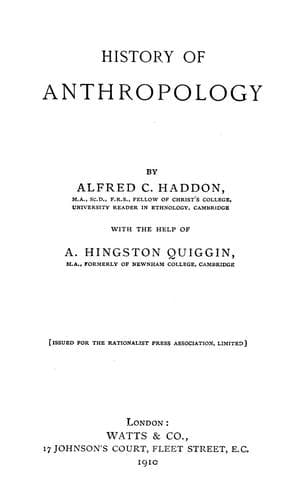
History of anthropologyHaddon, Alfred C. (Alfred Cort)
History
History of anthropology
Haddon, Alfred C. (Alfred Cort)
Anthropology -- History
When materials began to accumulate they were detrimental to the
polygenist theory. Especially was this the case with regard to the proof
of what Broca termed “_eugenesis_”—_i.e._, that all the _Hominidæ_ are,
and always have been, fertile with each other. This, which formed a test
between species and varieties in Botany and Zoology, was claimed also in
Anthropology, and the polygenists had to seek for support elsewhere.
They found it in Linguistics; “language as a test of race” bulked large
in ethnological controversy, and is not yet entirely extinct.
At first the monogenists claimed language as supporting their views. All
languages were to be traced to three sources—Indo-European, Semitic, and
Malay; and these, in their turn, were the offspring of a parent tongue,
now entirely lost. But it was soon found impossible to reconcile even
Aryan and Semitic, and a common parent for all three languages was
inconceivable. The linguistic argument then passed over to the
polygenists.
Hovelacque stated that “the ascertained impossibility of reducing a
multiplicity of linguistic families to a common centre is for us
sufficient proof of the original plurality of the races that have been
developed with them.” M. Chavée[35] went further. “We might,” he says,
“put Semitic children and Indo-European children apart, who had been
taught by deaf mutes, and we should find that the former would naturally
speak a Semitic language, the latter an Aryan language.” F. Müller and
others took up this line of argument, holding that distinct stock
languages proved the existence of distinct stock races. But, as
Professor Keane points out, in his summary of the controversy (1896,
chap. vii.), _quod nimis probat, nihil probat_—what proves too much,
proves nothing—and the hundred or more stock languages in America alone,
reduced the argument to an absurdity.
Footnote 35:
See Topinard, 1878, p. 424.
[Sidenote: =Monogenists.=]
Among the monogenists may be included most of the older
anthropologists—Linnæus, Buffon, Blumenbach, Camper, Prichard, and
Lawrence. Since they held that all mankind was descended from a single
pair (the question as to whether this pair were white, black, or red,
occasioned a further discussion), they had to account for the subsequent
divergence producing the present clearly-recognised varieties; and, in
so doing, anticipated the theory of evolution, which was not clearly
enunciated until the time of Lamarck.
Public-domain text, read in full here on John Shaqi.
Reviews
Reviews
No reviews yet
Be the first to share your thoughts on this work.
Join the Discussion
Join the discussion
Sign in to leave a comment or review.
Sign InorCreate an account