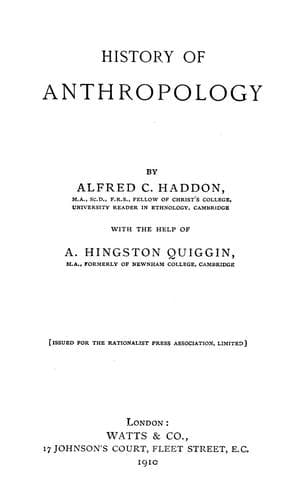
History of anthropologyHaddon, Alfred C. (Alfred Cort)
History
History of anthropology
Haddon, Alfred C. (Alfred Cort)
Anthropology -- History
Lawrence was far in advance of his time, and much of his teaching may be
said to have anticipated the doctrine of evolution. Unfortunately, the
theological protest raised by his lectures—published when he was only
thirty-five—resulted in his forsaking Anthropology altogether, and he
henceforward devoted himself entirely to anatomy and surgery.
[Sidenote: =Lord Monboddo.=]
Another prophet in advance of his times was Lord Monboddo. James Burnett
Monboddo (1714-1799) was regarded as one of the most eccentric
characters of the eighteenth century, mainly on account of his peculiar
views about the origin of society and of language, and his theories as
to the relationship of man with the monkeys. He was deeply interested in
all the current accounts of “tailed men,” thus justifying Dr. Johnson’s
remark that he was “as jealous of his tail as a squirrel.” Later
students of his writings are less struck by these eccentricities, which
afforded endless jests to the wags of the age, than by his scientific
methods of investigation and his acute conclusions. He not only studied
man as one of the animals, but he also studied savages with a view to
elucidating the origin of civilisation.
Many other pre-Darwinian evolutionists might be mentioned, but Professor
Lovejoy’s caution must be noted:—
The premature adoption of a hypothesis is a sin against the
scientific spirit; and the chance acceptance by some enthusiast
of a truth in which, at the time, he has no sound reason for
believing, by no means entitles him to any place of honour in
the history of science.[37]
Footnote 37:
_Pop. Sci. Monthly_, 1909, p. 499.
The first to enunciate a coherent theory of evolution—that of
Transformism or Transmutation—was Lamarck.[38]
Footnote 38:
De Maillet and Robinet had already outlined part of the Lamarckian
doctrine.
[Sidenote: =Lamarck.=]
Lamarck (1744-1829) believed that species were not fixed, but that the
more complex were developed from pre-existent simpler forms. He
attributed the change of species mainly to physical conditions of life,
to crossing, and especially to use or disuse of organs, which not only
resulted in the modification, growth, or atrophy of some, but, under the
stress of necessity, led to the formation of new ones. “_La fonction
fait l’organe._” He also held that changes produced in the individual as
the result of environment were transmitted to the offspring. Organic
life was traced back and back to a small number of primordial germs or
monads, the offspring of spontaneous generation. Man formed no
exception. He was the result of the slow transformation of certain apes.
Lamarck’s views were first published in 1801, and were enlarged in his
_Philosophie Zoologique_, 1809.
[Sidenote: =Cuvier.=]
Public-domain text, read in full here on John Shaqi.
Reviews
Reviews
No reviews yet
Be the first to share your thoughts on this work.
Join the Discussion
Join the discussion
Sign in to leave a comment or review.
Sign InorCreate an account