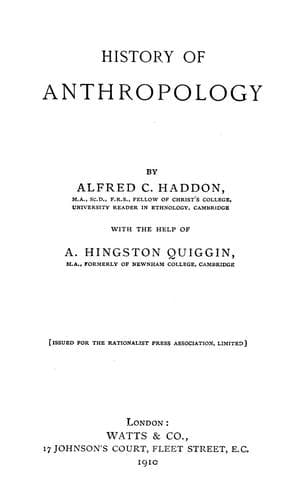
History of anthropologyHaddon, Alfred C. (Alfred Cort)
History
History of anthropology
Haddon, Alfred C. (Alfred Cort)
Anthropology -- History
Lamarck’s chief opponent was Cuvier (1769-1832), Professor of Natural
History and of Comparative Anatomy in Paris, who, besides being the
recognised authority on zoology (his great book, _Le Règne Animal_, was
long the standard work on the subject), was even more renowned as an
anatomist. He upheld the theory of Catastrophe, of alternate
destructions and regenerations, against the new theories of Transformism
and Evolution.
According to this widely accepted belief, the universe was subject to
violent terrestrial revolutions, involving the destruction of all
existing things and the total annihilation of all living beings
belonging to the past epoch.
The theory was by no means new; it was current in the East in the
thirteenth century. In a book written by Mohamed Kaswini on the wonders
of nature, he tells the following tale:—
In passing one day by a very ancient and extremely populous
city, I asked of one of the inhabitants who founded their city.
He replied to me: “I know not, and our ancestors knew no more
than we do on this point.” Five hundred years afterwards,
passing by the same place, I could not perceive a trace of the
city. Inquiring of one of the peasants about the place when it
was that the city was destroyed, he answered me: “What an odd
question you put to me; this country has never been otherwise
than as you see it now.” I returned there after another five
hundred years, and I found in the place of the country I had
seen—a sea. I now asked of the fishermen how long it was since
their country became a sea; and he replied that a person like me
ought to know that it had always been a sea. I returned again
after five hundred years; the sea had disappeared, and it was
now dry land. No one knew what had become of the sea, or if such
a thing had ever existed. Finally, I returned once more after
five hundred years, and I again found a flourishing city. The
people told me that the origin of their city was lost in the
night of time.[39]
Footnote 39:
Quoted from R. Knox, _Anth. Rev._, i., 1863, p. 263.
Cuvier’s position was supported by the evidence brought to France by
Napoleon’s scientific expedition to Egypt (1801). Here were seen numbers
of mummified animals, probably dating back some three to four thousand
years, but showing no appreciable difference from existing types. This
was held to demolish the theory of evolution by proving the immutability
of species.
[Sidenote: =Étienne Saint-Hilaire.=]
Public-domain text, read in full here on John Shaqi.
Reviews
Reviews
No reviews yet
Be the first to share your thoughts on this work.
Join the Discussion
Join the discussion
Sign in to leave a comment or review.
Sign InorCreate an account