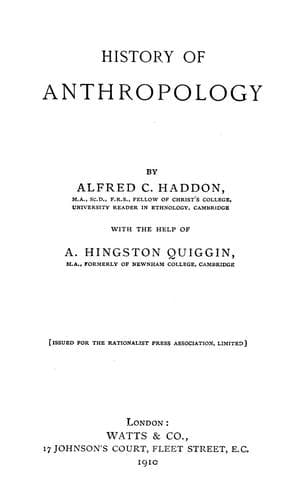
History of anthropologyHaddon, Alfred C. (Alfred Cort)
History
History of anthropology
Haddon, Alfred C. (Alfred Cort)
Anthropology -- History
The truth is that Huxley’s strongly emotional and highly
pugnacious nature was held back by certain wholly non-logical
influences from accepting an hypothesis for which the evidence
was practically as potent for over a decade before he accepted
it as it was at the time of his conversion. The book was written
in a somewhat exuberant and rhetorical style. With all its
religious heterodoxy, it was characterised by a certain pious
and edifying tone, and was given to abrupt transitions from
scientific reasoning to mystical sentiment. It contained
numerous blunders in matters of biological and geological
detail; and its author inclined to believe, on the basis of some
rather absurd experimental evidence, in the possibility of
spontaneous generation. All these things were offensive to the
professional standards of an enthusiastic young naturalist,
scrupulous about the rigour of the game, intolerant of vagueness
and of any mixture of the romantic imagination with scientific
inquiry.... He therefore, in 1854, almost outdid the _Edinburgh
Review_ in the ferocity of his onslaught upon the layman who had
ventured to put forward sweeping generalisations upon biological
questions while capable of errors upon particular points which
were palpable to every competent specialist.
Huxley refers to this review as “the only review I ever have had qualms
of conscience about, on the grounds of needless savagery.” Darwin more
mildly described it as “rather hard on the poor author.” Indeed, he
confessed to a certain sympathy with the _Vestiges_; while Wallace, in
1845, expressed a very favourable opinion of the book, describing it as
“an ingenious hypothesis, strongly supported by some striking facts and
analogies.”
The strongest testimony to the value of Chambers’s work is that of Mr.
A. W. Benn, who writes in _Modern England_, 1908, concerning the
_Vestiges_:—
Hardly any advance has since been made on Chambers’s general
arguments, which at the time they appeared would have been
accepted as convincing, but for theological truculence and
scientific timidity. And Chambers himself only gave unity to
thoughts already in wide circulation.... Chambers was not a
scientific expert, nor altogether an original thinker; but he
had studied scientific literature to better purpose than any
professor.... The considerations that now recommend evolution to
popular audiences are no other than those urged in the
_Vestiges_.
[Sidenote: =Herbert Spencer.=]
The next great name among the pre-Darwinian evolutionists is that of
Herbert Spencer. About 1850 he wrote:—
Public-domain text, read in full here on John Shaqi.
Reviews
Reviews
No reviews yet
Be the first to share your thoughts on this work.
Join the Discussion
Join the discussion
Sign in to leave a comment or review.
Sign InorCreate an account