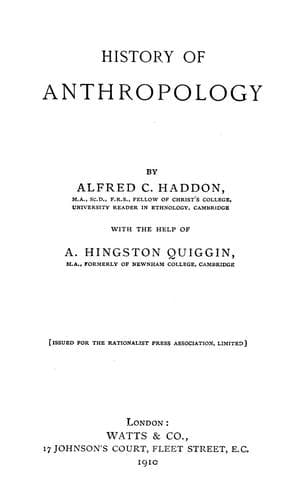
History of anthropologyHaddon, Alfred C. (Alfred Cort)
History
History of anthropology
Haddon, Alfred C. (Alfred Cort)
Anthropology -- History
Étienne Geoffrey Saint-Hilaire (1772-1844), the zoologist on the
Egyptian expedition, interpreted the results differently, and was one of
the most brilliant supporters of Lamarck. In 1828 he published his
convictions that the same forms have not been perpetuated since the
origin of all things, though he did not believe that existing species
were undergoing modification. Cuvier returned to the charge, and in 1856
propounded his doctrine of the periodical revolutions of the earth, of
the renewal each time of the flora and fauna, and of the incessant and
miraculous intervention of a creative Will. And for a time, owing to his
position and authority, he held the field.
[Sidenote: =Robert Chambers.=]
In 1844 appeared a book which had an enormous influence on the
pre-Darwinian history of Evolution. This was an anonymous work entitled
_Vestiges of the Natural History of Creation_, the authorship of which
was not revealed until the publication of the twelfth edition in 1884.
It was the production of Robert Chambers (1802-1871), co-editor with his
brother William of _Chambers’s Journal_, and author of many books on
Scotland and a few on science. He traced the action of general laws
throughout the universe as a system of growth and development, and held
that the various species of animals and plants had been produced in
orderly succession from each other by the action of unknown laws and the
influence of external conditions. The _Vestiges_ became at once the
centre of scientific discussion, denounced by the orthodox, and held
“not proven” by most of the men of science of the time. Its supporters
were called “Vestigiarian,” a term which implied also “unscientific,”
“sentimental,” and “absurd.”
The curious point is that in the _Vestiges_ we find much of what was
subsequently called the Darwinian theory already enunciated. According
to Wallace, it clearly formulated the conception of evolution through
natural laws, and yet it was denounced by those who soon after were to
become the champions of Darwinism. This was partly due to the way in
which the doctrine was treated and expressed, partly also to the
“needless savagery” of Professor Huxley.
Huxley wrote in 1887: “I must have read the _Vestiges_ ... before 1846;
but, if I did, the book made very little impression on me.... I confess
the book simply irritated me by the prodigious ignorance and thoroughly
unscientific habit of mind manifested by the writer.” Professor
Lovejoy[40] explains the reasons for Huxley’s attitude:—
Footnote 40:
_Loc. cit._
Public-domain text, read in full here on John Shaqi.
Reviews
Reviews
No reviews yet
Be the first to share your thoughts on this work.
Join the Discussion
Join the discussion
Sign in to leave a comment or review.
Sign InorCreate an account