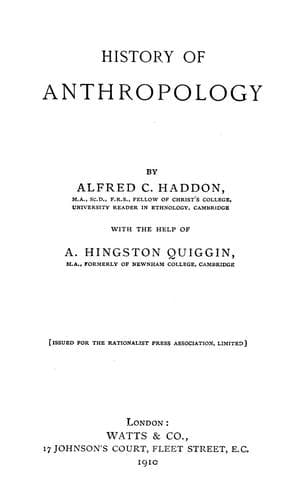
History of anthropologyHaddon, Alfred C. (Alfred Cort)
History
History of anthropology
Haddon, Alfred C. (Alfred Cort)
Anthropology -- History
As Professor Sollas points out, “the primitive inhabitants of France
were distinguished from the highest civilized races, not by a smaller,
but by a larger, cranial capacity; in other words, as we proceed
backwards in time the human brain increases in volume.”[55] We know that
they buried their dead, and in some cases provided weapons and food for
use in a future state. Their inventiveness is proved by the variety and
gradual improvement in the technique of their tools and weapons. Their
carvings in the round or low relief, their spirited engravings on bone
and ivory, and their wonderful mural paintings, whether in outline,
shaded monochrome, or polychrome, evince an astonishing æsthetic sense
and technical skill.
Footnote 55:
_Quart. Journ. Geol. Sci._, vol. 66, 1910, p. lxii.
As the diggers in Mesopotamia, Egypt, Greece, Crete, and elsewhere, have
proved that civilisation was far more ancient than could have been
conceived even fifty years ago, so the cave explorers have shown us that
during the latter half of the Palæolithic age there lived mighty
hunters, skilful artists, big-brained men, who laid the foundations upon
which subsequent generations have built. This, then, is the lesson that
the latest results of investigations into the antiquity of man has
taught us—that brain, not brawn, has been the essential factor in the
evolution of man. The human brain had developed at a greater rate than
the body, which even then retained unmistakable evidence of man’s lowly
origin. How long had this evolution been progressing before Mousterian
times?[56] The ruder stone implements of the Acheulian and Chellian
epochs carry us an appreciable time backward; and if even some of the
eoliths are artifacts, we can project tool-using man to yet earlier
times. Then the record becomes blurred, as it is manifestly impossible
to decide whether simple bruising of stones was caused by man or natural
agencies.
Footnote 56:
W. L. H. Duckworth, _Morphology and Anthropology_, 1904, p. 520.
[Sidenote: =Pithecanthropus erectus.=]
Public-domain text, read in full here on John Shaqi.
Reviews
Reviews
No reviews yet
Be the first to share your thoughts on this work.
Join the Discussion
Join the discussion
Sign in to leave a comment or review.
Sign InorCreate an account