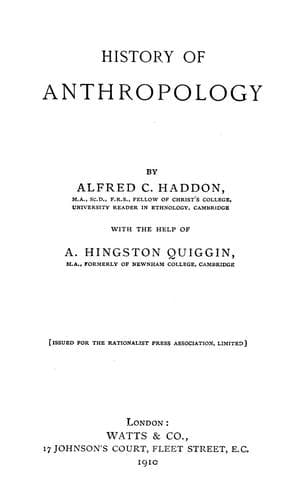
History of anthropologyHaddon, Alfred C. (Alfred Cort)
History
History of anthropology
Haddon, Alfred C. (Alfred Cort)
Anthropology -- History
Professor Michael Foster somewhere remarked that “hypothesis is the salt
of science.” The main difficulty with which observers in the field have
to contend is that, as a rule, they can see only what they look for.
When an investigator has left his field and is working up his results at
home, he only too frequently finds that he has omitted to look for
certain customs or beliefs, whose occurrence in other places he had
either over-looked or forgotten. This is the justification for the
questionnaires. It is one of the most important functions of
stay-at-home synthetic students laboriously to cull data from the vast
literature of anthropology, travel, and ancient and modern history, and
to weld them into coherent hypotheses. The student at home in this way
suggests fresh inquiries to the field ethnologist, and a richer harvest
is the result. The most valuable generalisations are made, however, when
the observer is at the same time a generaliser; but “doubtless,” as
Maharbal said to Hannibal after the battle of Cannae, “the gods have not
bestowed everything on the same man. You, Hannibal, know how to conquer;
but you do not know how to use your victory.”
The vastness of the anthropological sciences and the nebulous character
of their demarcation from other sciences render their definition or
classification a peculiarly difficult matter. Even at the present day
students are not agreed upon the exact terminology and limitations of
the various branches of their subject; but, after all, these are little
more than academic discussions, since investigations go on irrespective
of boundary lines. Those who are really worried about this
“terminological inexactitude” are the cataloguers and librarians, who
frequently are at a loss where to place items in their catalogues or
books on their shelves. It was mainly from this point of view that
Dieserud was constrained to write his _Science of Anthropology: Its
Scope and Content_.[1] This useful little book deals very fully in
historical order with the questions referred to above, and it may be
recommended to those who are interested in these somewhat profitless
discussions.
Footnote 1:
This is the title on the back of the book. Its designation on the
title-page is given correctly in the Bibliography.
For the convenience of those who require landmarks we here give the
scheme that is roughly followed in this book, which is based upon the
classification recently proposed by the Board of Studies in Anthropology
of the University of London as a guide for the study and teaching of
Anthropology:—
_A._—PHYSICAL ANTHROPOLOGY (Anthropography, Anthropology of some
writers)
(_a_) _Zoological_ (somatology, including craniology, etc.).—Man’s
place in Nature as evidenced by the study of comparative
anatomy and physiology, more especially of the
Anthropoidea.
Public-domain text, read in full here on John Shaqi.
Reviews
Reviews
No reviews yet
Be the first to share your thoughts on this work.
Join the Discussion
Join the discussion
Sign in to leave a comment or review.
Sign InorCreate an account