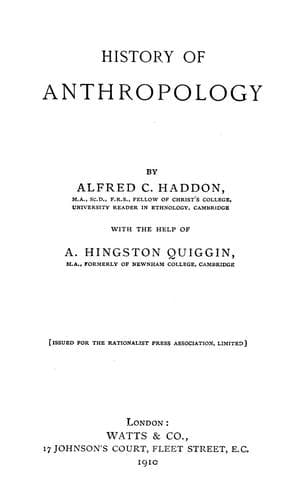
History of anthropologyHaddon, Alfred C. (Alfred Cort)
History
History of anthropology
Haddon, Alfred C. (Alfred Cort)
Anthropology -- History
(_b_) _Palæontological._—The antiquity of man as evidenced by fossil
and semi-fossilised remains, including the geological
evidence.
(_c_) _Physiological and Psychological._—The comparative study of the
bodily functions and mental processes.
(_d_) _Ethnological._—The comparative study of the physical characters
which distinguish the various races and sub-races of man.
Classification of the human race in accordance with
physical and psychical characters. Geographical
distribution of the varieties of mankind. The influence
of environment on physique.
_B._—CULTURAL ANTHROPOLOGY (Ethnology of some writers).
(_a_) _Archæological._—The antiquity of man as revealed by the
earliest remains of his handiwork. The prehistoric
periods; their characteristics, sequence, and duration.
The survival of early conditions of culture in later
times (Folklore).
(_b_) _Technological._—The comparative study of arts and industries;
their origin, development, and geographical distribution.
(_c_) _Sociological._—The comparative study of social phenomena and
organisation. Birth, education, marriage, and death
customs and systems. Social and religious associations.
Government and laws. Moral ideas and codes. Magical and
religious ideas and practices.
(_d_) _Linguistic._—The comparative study of language.
(_e_) _Ethnological._—The comparative study and classification of
peoples based upon cultural conditions and
characteristics. The influence of environment upon
culture.
------------------------------------------------------------------------
CHAPTER I.
THE PIONEERS OF PHYSICAL ANTHROPOLOGY
[Sidenote: =Definition of the word “Anthropology.”=]
ARISTOTLE, “the father of them that know,” as Dante called him, is
credited with having coined the word “anthropologist”; but he did not
employ it in a very complimentary sense. Describing a lofty-minded man
in his _Ethics_, he terms him ουκ ανθρωπολογος—not a gossip, not a
talker about himself. But the word does not seem to have supplied a
permanent want in the Greek world, and we meet it next in a Latin form
in the sixteenth century. _Anthropologium_ was then used in a restricted
sense, relating to man’s bodily structure; and the first work in which
it occurs is generally stated to be Magnus Hundt’s _Anthropologium de
hominis dignitate_, which appeared in 1501, and dealt in a general way
with human anatomy and physiology.
Public-domain text, read in full here on John Shaqi.
Reviews
Reviews
No reviews yet
Be the first to share your thoughts on this work.
Join the Discussion
Join the discussion
Sign in to leave a comment or review.
Sign InorCreate an account