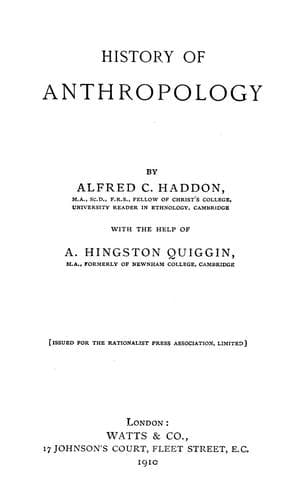
History of anthropologyHaddon, Alfred C. (Alfred Cort)
History
History of anthropology
Haddon, Alfred C. (Alfred Cort)
Anthropology -- History
Lucretius (99 or 98-55 B.C.), the poet, teacher, and reformer, boldly
declared that there was no Golden Age from which man has degenerated,
but that his progress has continually been slowly upward from a
condition of pure savagery:—
Arms of old were hands nails and teeth and stones and boughs
broken off from the forests, and flame and fire, as soon as they
had become known. Afterwards the force of iron and copper was
discovered; and the use of copper was known before that of iron,
as its nature is easier to work and it is found in greater
quantity. With copper they would labour the soil of the earth,
with copper stir up the billows of war.... Then by slow steps
the sword of iron gained ground and the make of the copper
sickle became a byword; and with iron they began to plough
through the earth’s soil, and the struggles of wavering war were
rendered equal.[81]
Footnote 81:
Lucretius, _On the Nature of Things_. Translated by H. A. J. Munro.
Bohn’s edition, 1908, p. 214.
It is evident from his poems that Lucretius was a keen observer and a
philosopher, who summed up existing Epicurean knowledge; and we are
justified in believing that these particular generalisations were based
upon tales told by travellers in distant lands, and upon traditional
lore, which, with the exception of the recently acquired archæological
evidence, is practically all upon which we have to rely. The philosophic
poet apprehended the significance of various facts, and welded them into
a consistent theory of the development of culture, and thereby earned
the honour of being the first evolutionary anthropologist.
[Sidenote: =Strabo.=]
Nor should we overlook the versatile Strabo (_circa_ 63 B.C.-21 A.D.),
who was interested in many things, from climate to botany, and from
sport to Druidism and Brahmanism. Alexander von Humboldt considered that
he surpassed all other geographical labourers of antiquity by the
diversity of the subject and the grandeur of the composition. His
_Geography_ contains much information on the early history and
traditions of numerous peoples, their character, dress, dwellings, and
mode of life.
Public-domain text, read in full here on John Shaqi.
Reviews
Reviews
No reviews yet
Be the first to share your thoughts on this work.
Elsewhere in the archive
Join the Discussion
Join the discussion
Sign in to leave a comment or review.
Sign InorCreate an account