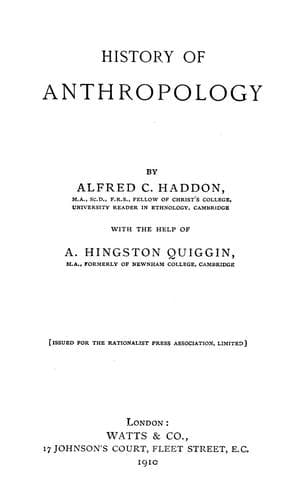
History of anthropologyHaddon, Alfred C. (Alfred Cort)
History
History of anthropology
Haddon, Alfred C. (Alfred Cort)
Anthropology -- History
The first appearance of the word in English was probably in the
seventeenth century, when an anonymous book was published bearing the
title _Anthropologie Abstracted; or, The idea of Humane nature reflected
in briefe Philosophicall and anatomical collections_ (1655). The author
defines his subject thus:—
Anthropologie, or the history of human nature, is, in the vulgar
(yet just) impression, distinguished into two volumes: the first
entitled _Psychologie_, the nature of the rational soule
discoursed; the other anatomie, or the fabrick or structure of
the body of man revealed in dissection ... of the former we
shall in a distracted rehersall, deliver our collections.[2]
Footnote 2:
See Bendyshe, p. 356.
The meaning of the word was scarcely clear in the beginning of the
nineteenth century, when we find, in the _British Encyclopædia_ of 1822,
the following definitions, “A discourse upon human nature,” and “Among
Divines, that manner of expression by which the inspired writers
attribute human parts and passions to God.”
Concerning the present use of the term “Anthropology,” few will take
exception to the definition given by Topinard in his _l’Anthropologie_
(1876): “Anthropology is the branch of natural history which treats of
man and the races of man.” It may be yet more succinctly described as
“the science of man,” which comprises two main divisions—the one which
deals with the natural man (ανθρωπος, or _homo_); the other which is
concerned with man in relation to his fellows, or, in other words, with
social man (εθνορ, or _socius_). At the end of the Introduction we give
the classification which we propose to adopt. It should, however, be
stated that, whereas in this country we employ the term “Anthropology”
to cover the whole subject, it is common on the Continent to restrict
the term to what we designate as “Physical Anthropology,”
“Anthropography,” or “Somatology.”
[Sidenote: =Fundamental Conceptions.=]
The beginnings of anthropology may probably be traced to what Professor
Giddings (1896) has termed the “consciousness of kind,” but what Dr.
McDougall (1898) has more definitely recognised as showing the
gregarious impulse. He says (pp. 299-300):—
The gregarious impulse of any animal receives satisfaction only
through the presence of animals similar to itself, and the
closer the similarity the greater is the satisfaction.... Just
so, in any human being the instinct operates most powerfully in
relation to, and receives the highest degree of satisfaction
from the presence of, the human beings who most closely resemble
that individual, those who behave in like manner and respond to
the same situations with similar emotions.
[Illustration:
_Andree, Parallelen. N. r. Tafel. III._
BUSHMEN RAIDING KAFIR CATTLE.
(_After R. Andree._)
]
------------------------------------------------------------------------
[Illustration:
Public-domain text, read in full here on John Shaqi.
Reviews
Reviews
No reviews yet
Be the first to share your thoughts on this work.
Join the Discussion
Join the discussion
Sign in to leave a comment or review.
Sign InorCreate an account