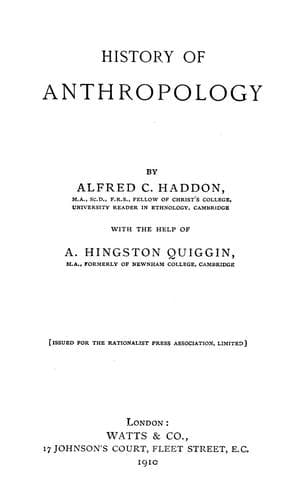
History of anthropologyHaddon, Alfred C. (Alfred Cort)
History
History of anthropology
Haddon, Alfred C. (Alfred Cort)
Anthropology -- History
Brit. Ass., Belfast, 1874.
Much of this evidence already existed, but even when rightly interpreted
it was for a long time ignored and scoffed at. It has been noted in the
life-history of a scientific truth, “People first say, ‘It is not true,’
then that ‘It is contrary to religion,’ and lastly that ‘Everybody knew
it before.’” The first attitude of incredulity was to a great extent
justified by the doubtful character of the earlier finds, many of which
later investigation has had to reject or to hold in suspense as “not
proven.” The second stage was more serious, and for a long time the new
science was hampered by the accusation of irreligion. But
“Anthropology,” as Huxley pointed out, “has nothing to do with the truth
or falsehood of religion.” “_Je suis naturaliste_,” said Abbé Bourgeois,
“_je ne fais pas de théologie_.”
Gradually the accumulated evidence became too insistent to be ignored.
The work of various archæologists in Denmark, the explorations of caves
and lake dwellings in Britain and on the Continent, and the patient
labours of Boucher de Perthes in the Somme Valley, all gave proof of the
existence of prehistoric man, and the science of prehistoric archæology
was established.
[Sidenote: =Flint Implements.=]
Long before this time, as far back as the sixteenth century, flint
implements had been discovered in various parts, and proved as great a
puzzle as the fossils which perplexed and tried the faith of the earlier
geologists.
The uncultured folk of Europe recognised that the chipped arrow-heads
which occasionally occur on the surface of the ground were the
implements of an alien people, as the names “elf darts” and “fairy
darts” imply. The country folk in the more backward districts believe
that fairies still exist; but better informed intelligent people believe
they are purely mythological, while students are aware that these
arrow-heads were the implements of earlier populations, who are classed
in folk-memory under the generic term of “fairies.”
Typical neolithic implements, such as stone adze and axe heads, had
attracted the attention of writers in the Middle Ages, such as Gesner
and Agricola, who, as Sir John Evans[86] informs us, regarded them as
thunder-bolts—a belief which is still widely spread not only in Europe,
but over the greater portion of the Old World. But Mercati, physician to
Clement VIII. at the end of the sixteenth century, appears to have been
the first to maintain that what were regarded as thunderbolts were the
arms of a primitive people unacquainted with the use of bronze or iron.
Certain later writers, as de Boot (1636) and la Peyrère (1655), also
regarded them as of human workmanship. Buffon, too, in 1778, declared
the “thunder-stones” to be the work of primeval man.
Footnote 86:
_Ancient Stone Implements_, 1872; 2nd ed. 1897, chap. iii.
Public-domain text, read in full here on John Shaqi.
Reviews
Reviews
No reviews yet
Be the first to share your thoughts on this work.
Elsewhere in the archive
Join the Discussion
Join the discussion
Sign in to leave a comment or review.
Sign InorCreate an account