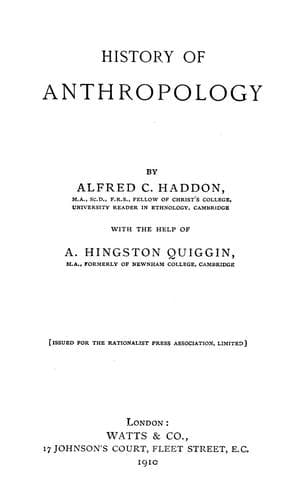
History of anthropologyHaddon, Alfred C. (Alfred Cort)
History
History of anthropology
Haddon, Alfred C. (Alfred Cort)
Anthropology -- History
In 1797 John Frere found numerous flint implements at a depth of about
twelve feet in some clay pits at Hoxne, Suffolk, and referred them to “a
very remote period indeed, even beyond that of the present world, and to
a people who had not the use of metals.”[87]
Footnote 87:
_Archæologia_, xiii., p. 204.
But the discovery does not seem to have attracted any interest, or
raised any discussion; and the Hoxne implements lay unnoticed for more
than half a century, until Evans, returning from Amiens and Abbeville in
1859, recognised the importance of the collections, and by further
excavations proved their antiquity.
The belief of the Middle Ages, that everything inexplicable was the work
of the Devil, was succeeded by an ascription of all objects of unknown
antiquity to the Druids or the Romans; but to neither of these could be
attributed the finds which were being made at the beginning of the
nineteenth century in the Danish kitchen-middens and dolmens, in the
Swiss lake dwellings, and in the caves and gravels of Britain and of
France. Still many years were to pass, and many heated discussions were
to be held, before archæology came to be recognised as an ally of
anthropology, and Prehistoric Man obtained credence.
[Sidenote: =Denmark.=]
In this new science Denmark took the lead. In 1806 a Commission was
appointed to make a scientific investigation into the history, natural
history, and geology of the country; and among the first problems to be
met with were the dolmens and shell-mounds, abounding in stone
implements, which found no period in Danish history capable of
accommodating them. History and the sagas were searched in vain.
Meanwhile more and more of these prehistoric implements were brought to
light. A new Commission was appointed, and the various sites were
carefully examined. The collection of Professor R. Nyerup formed, in
1810, the nucleus which, in 1816, expanded into the Royal Danish Museum
of Antiquities at Copenhagen, now, as the National Museum, lodged in the
Princessen Palace. C. J. Thomsen held the post of curator from 1816 to
1865. He ordered, arranged, and classified the collections, dividing the
objects according to their epoch of culture, and setting them in
chronological order, establishing the sequence of the Stone, Bronze, and
Iron Ages. This was the first attempt to classify the archæological
contents of a museum on a chronological basis, and it was continued,
elaborated, and developed by his successor, Professor J. J. A. Worsaae,
1865 to 1885.[88]
Footnote 88:
The classification itself was not new; it had been adumbrated by many
writers. See Evans, 1872, pp. 3 ff.
[Sidenote: =Caves.=]
Another class of evidence which was of great importance in determining
the pre-history of man was that derived from the caves. The beginnings
of cave-exploration are described by Professor Boyd Dawkins:—
Public-domain text, read in full here on John Shaqi.
Reviews
Reviews
No reviews yet
Be the first to share your thoughts on this work.
Elsewhere in the archive
Join the Discussion
Join the discussion
Sign in to leave a comment or review.
Sign InorCreate an account