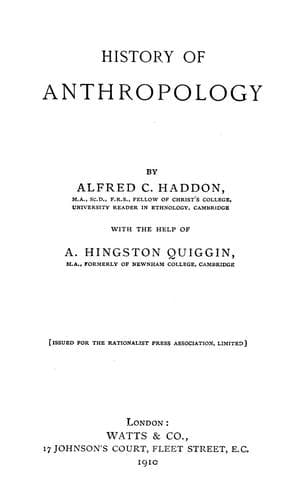
History of anthropologyHaddon, Alfred C. (Alfred Cort)
History
History of anthropology
Haddon, Alfred C. (Alfred Cort)
Anthropology -- History
The dread of the supernatural, which preserved the European
caves from disturbance, was destroyed in the sixteenth and
seventeenth centuries by the search after “ebur fossile,” or
unicorn’s horn, which ranked high in the materia medica of those
days as a specific for many diseases, and which was obtained, in
great abundance, in the caverns of the Hartz, and in those of
Hungary and Franconia. As the true nature of the drug gradually
revealed itself, the German caves became famous for the remains
of the lions, hyænas, fossil elephants, and other strange
animals, which had been used for medicine.[89]
Footnote 89:
_Cave Hunting_, p. 11.
These caves were investigated mainly by geologists or palæontologists,
searching for evidence as to the extinct animals that formerly occupied
them. Indications of the presence of man were unsuspected, and, if
found, disregarded. Thus much of the evidence of man’s early history was
doubtless unwittingly destroyed.
The Franconian caves were explored towards the end of the eighteenth
century, and described by Esper (1774), Rosenmüller (1804), and Dr.
Goldfuss (1810). The most famous of these was the cave of Gailenreuth.
Here, for the first time, investigations were carried out
systematically, the finds classified, and, since they indicated the
co-existence of man and extinct mammals, theories as to their
significance and derivation filled the air.
In 1861 William Buckland (1784-1856), Professor of Mineralogy at Oxford
(afterwards Dean of Westminster), visited the caves, and kindled that
interest in cave-exploration which was to produce such remarkable
results in England.
[Sidenote: =Oreston.=]
In the same year the first bone-cave systematically explored in the
country was discovered at Oreston, near Plymouth, and the deposits
proved the former existence of the rhinoceros in that region.
[Sidenote: =Kirkdale.=]
More famous was the exploration of the Kirkdale Cave, near Helmsley, in
Yorkshire, discovered in 1821, in a limestone quarry, and investigated
and described by Dr. Buckland.[90] He found remains of the broken and
gnawed bones of the rhinoceros, mammoth, stag, bison, etc., which had
been the prey of the hyænas inhabiting the cave, and he traced their
origin to a universal deluge. Subsequently he examined the remains from
other caves, and summarised his conclusions in _Reliquiæ Diluvianæ_,
published in 1824. Dr. Buckland was henceforward the acknowledged
authority on bone caves and their contents, and to his disbelief in the
contemporaneous existence of man with the cave animals may be traced
much of the incredulity with which all evidence of early man in Britain
was received for more than a generation.
Footnote 90:
_Phil. Trans. Roy. Soc._, 1882.
Public-domain text, read in full here on John Shaqi.
Reviews
Reviews
No reviews yet
Be the first to share your thoughts on this work.
Elsewhere in the archive
Join the Discussion
Join the discussion
Sign in to leave a comment or review.
Sign InorCreate an account