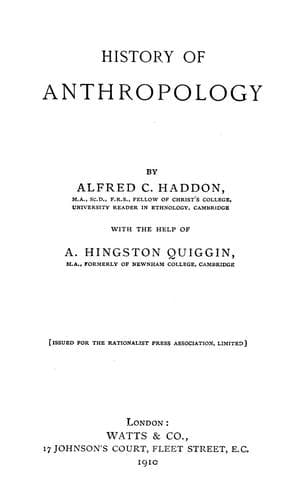
History of anthropologyHaddon, Alfred C. (Alfred Cort)
History
History of anthropology
Haddon, Alfred C. (Alfred Cort)
Anthropology -- History
Magic and religion are very generally held to be not only distinct from
one another, but antithetical. There is, however, a tendency among
certain living students to regard them as analogous phenomena, both
being expressions of a belief in a power or energy which may be
designated by the Melanesian term “mana,” or the American “orenda.” It
has more than once been pointed out that it is in some cases very
hard—perhaps impossible—to determine whether certain actions can be
classed as either magical or religious, as they appear to belong to both
categories. As in the case of religion from the ethnological standpoint,
magic has been investigated in the field, and immediate references to it
are to be found in ethnological literature—the comparative study of
magic has to some extent been undertaken by Frazer, Jevons, and others;
but one of the most important contributions to the subject is by Hubert
and Mauss,[110] who treat it from a sociological aspect.
Footnote 108:
_An Introduction to Social Psychology_, 1908.
Footnote 109:
_Congress of Arts and Sci., St. Louis_, 1904, v. (1906), p. 869.
Footnote 110:
H. Hubert et M. Mauss, “Esquisse d’une théorie générale de la magie,”
_L’Année sociologique_, vii., 1904. M. Mauss, “L’Origine des pouvoirs
magiques dans les sociétés Australiennes,” _École pratique des Haute
Études_ (Sec. Relig.), 1904.
[Sidenote: =Anthropology and Religion.=]
Parson Thwackum in _Tom Jones_ says: “When I mention religion I mean the
Christian religion; and not only the Christian religion, but the
Protestant religion; and not only the Protestant religion, but the
Church of England.” Anthropology, by a reverse process, passes “in
larger sympathy from specific creeds to partake of the universal spirit
which every creed tries to embody.”[111] The interest of Anthropology in
religion was defined by Huxley.[112] “Anthropology has nothing to do
with the truth or falsehood of religion—it holds itself absolutely and
entirely aloof from such questions—but the natural history of religion,
and the origin and growth of the religions entertained by the different
tribes of the human race, are within its proper and legitimate
province.”
Footnote 111:
Clodd, _Animism_, 1905, p. 11.
Footnote 112:
Address to Dept. of Anthrop., Brit. Ass. Dublin, 1878.
This is not the place to attempt a definition of religion—a task which
has led to so many failures. We must be content with the statement that
it most frequently presents itself under the aspects of ritual, myth,
and belief. Anthropology has hitherto practically confined its attention
to ritual and myth, and but too frequently exclusively to the last.
Public-domain text, read in full here on John Shaqi.
Reviews
Reviews
No reviews yet
Be the first to share your thoughts on this work.
Elsewhere in the archive
Join the Discussion
Join the discussion
Sign in to leave a comment or review.
Sign InorCreate an account