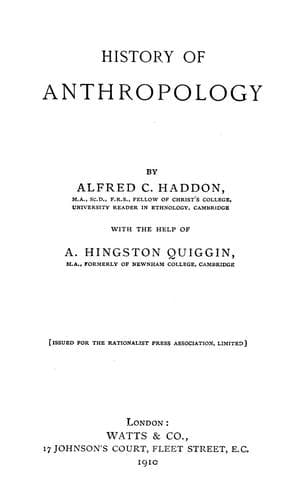
History of anthropologyHaddon, Alfred C. (Alfred Cort)
History
History of anthropology
Haddon, Alfred C. (Alfred Cort)
Anthropology -- History
Belonging to the fifth century B.C. are the realistic portraiture
figurines in pottery discovered by Professor Flinders Petrie at
Memphis,[5] “which clearly are copied from various races which were
welded together by the Persians, and who all met in the foreign
settlement at Memphis.” Professor Petrie identifies Sumerians or
Accadians, the old Turanian people who started civilisation in
Babylonia. “Their heads are identified by closely similar portraits
carved in stone about 3000 B.C., and found in Mesopotamia.” Persians,
Scythians, Mongols, and even Indians, are also recognised by him; but
some of the latter are dated by him at about 200 B.C.
Footnote 5:
Poole, _l.c._
Assyrian monuments are less explicit in this respect.
The Assyrians themselves are shown to have been of a very pure
type of Semites; but in the Babylonians there is a sign of
Cushite blood.... There is one portrait of an Elamite (Cushite)
king on a vase found at Susa; he is painted black, and thus
belongs to the Cushite race. The Ethiopian type can be clearly
seen in the reliefs depicting the Assyrian wars with the kings
of Ethiopia; but it is hard to discriminate Arabs and Jews from
Assyrians; in fact, it is only in the time of good art that
distinctions are traceable.[6]
Footnote 6:
H. H. Risley, _The Tribes and Castes of Bengal: Ethnographic
Glossary_, i., 1892, p. xxxviii.
Rock carvings in Persia, Scythian coins, and numerous other monuments
and remains from other countries and belonging to diverse ages,
illustrate that the head-form, features, character of the hair and mode
of wearing it, ornaments, dress, and weapons, were all recognised as
means of discriminating between different peoples from the earliest
times.
Ancient literature, of which one example must suffice, tells the same
tale:—
The sense of differences of colour, which, for all our talk of
common humanity, still plays a great and, politically, often an
inconvenient part in the history of the world, finds forcible
expression in the Vedic descriptions of the people whom the
Aryans found in possession of the plains of India. In a
well-known passage the god Indra is praised for having protected
the Aryan colour, and the word meaning colour (_varna_) is used
down to the present day as the equivalent of caste, more
especially with reference to the castes believed to be of Aryan
descent.[7]
Footnote 7:
_Report Brit. Assoc._, 1881, p. 683.
Public-domain text, read in full here on John Shaqi.
Reviews
Reviews
No reviews yet
Be the first to share your thoughts on this work.
Join the Discussion
Join the discussion
Sign in to leave a comment or review.
Sign InorCreate an account