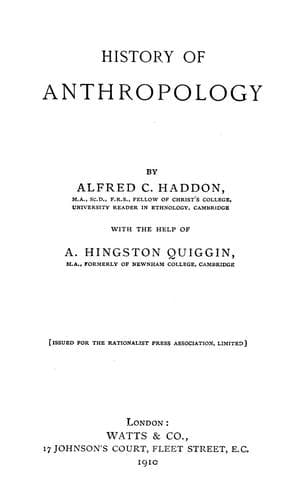
History of anthropologyHaddon, Alfred C. (Alfred Cort)
History
History of anthropology
Haddon, Alfred C. (Alfred Cort)
Anthropology -- History
Naturally the question of the identity of the Aryan race was soon a
subject of keen debate. The French and German schools at once assumed
opposite sides, the Germans claiming that the Aryans were tall, fair,
and long-headed, the ancestors of the modern Teutons; and the French,
mainly on cultural evidence, claiming that the language, together with
civilisation, came into Europe with the Alpine race, which forms such a
large element in the modern French population.
There are two ways in which linguistics may be studied as an aid to
Anthropology—first, with regard to structural analysis, by which
linguistic affinities may be proved; secondly, by what has been called
“linguistic palæontology,” or the study of root words, by means of which
the original culture of a people may be ascertained. Philology pushed
both these methods too far. It claimed the right, by proof of structural
analysis, to link up the racial relationships of the European and
Asiatic peoples, and, by linguistic palæontology, to determine the
culture of the original “Aryans,” and to identify their original home.
It was over the question of the “Aryan cradle” that they were forced to
relinquish their too ambitious claims.
At the beginning of the nineteenth century it was generally believed
that our first ancestors were created in 4004 B.C. and spoke Hebrew, and
that the origin of the European languages dated from the migration of
Japhet from the plains of Shinar, _cir._ 2247. The Asiatic origin of
race and language was for long unchallenged. But in 1839 Omalius
d’Halloy, followed by Latham in 1851, began to cast doubts on the
Asiatic “cradle,” noting that the Asiatic languages had no real claim to
be considered older than those of Europe, and that in many ways the
Lithuanian and Armenian were the most archaic in the family. More
important still was the work of Benfey,[125] who may be regarded as the
originator of linguistic palæontology, and who used its evidence to
shift the original dispersal from Asia to Europe. Various philologists
followed, employing different methods to prove different theories; and
the Aryan cradle was located in many parts of Europe and Asia, ranging
from the Pamir plateau to the Baltic plains. Max Müller confessed in
1888 that “the evidence is so pliant that it is possible to make out a
more or less plausible case” for almost any part of the world.
Footnote 125:
T. Benfey, in preface to Fick’s _Vergleichendes Wörterbuch der
Indogermanischen Sprachen_, 1868.
[Sidenote: =Language and Race.=]
From claiming too much the swing of the pendulum brought linguistics
into disrepute with ethnologists, and for a time the evidence of
language was looked upon with suspicion. Even philologists were accused
of going too far in this direction.
Public-domain text, read in full here on John Shaqi.
Reviews
Reviews
No reviews yet
Be the first to share your thoughts on this work.
Elsewhere in the archive
Join the Discussion
Join the discussion
Sign in to leave a comment or review.
Sign InorCreate an account