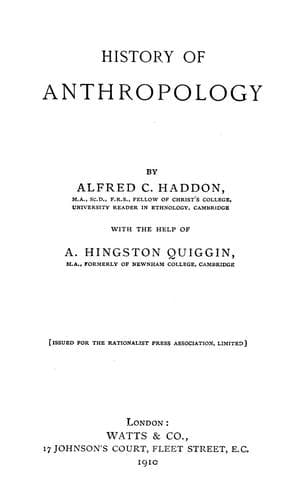
History of anthropologyHaddon, Alfred C. (Alfred Cort)
History
History of anthropology
Haddon, Alfred C. (Alfred Cort)
Anthropology -- History
Professor Sayce[126] says: “Identity or relationship of language can
prove nothing more than social contact.... Language is an aid to the
historian, not to the ethnologist.” But, as Professor Keane points out,
there are many cases in which language infallibly proves the existence
of ethnic elements which would otherwise have been unsuspected—as, for
example, in the case of the Basques of Europe. “Language used with
judgment is thus seen to be a great aid to the ethnologist in
determining racial affinities, and in solving many anthropological
difficulties” (1896, p. 205).
Although Max Müller wrote nearly twenty years ago, “I believe the time
will come when no anthropologist will venture to write on anything
concerning the inner life of man without having himself acquired a
knowledge of the language in which that inner life finds its truest
expression,” we are obliged still to echo his lament: “How few of the
books in which we trust with regard to the characteristics or
peculiarities of savage races have been written by men ... who have
learnt their languages until they could speak them as well as the
natives themselves!”[127]
Footnote 126:
_Science of Language_, ii., p. 317.
Footnote 127:
_Rep. Brit. Assoc._ (Cardiff), 1891, p. 792.
------------------------------------------------------------------------
CHAPTER XII.
CULTURAL CLASSIFICATION AND THE INFLUENCE OF ENVIRONMENT
WE have seen that in its beginning the science of man was little more
than a branch of zoology, and that his structural characters were the
first to attract attention and to form the material of study; hence all
the earlier classifications were based on physical features. Gallatin
was one of the first to classify mankind rather by what they _do_ than
by what they _are_.
[Sidenote: =Gallatin.=]
Albert Gallatin (1761-1849) was born at Geneva, emigrated to America
before he was twenty, and rose rapidly to the position of one of the
foremost of American statesmen, becoming United States Minister to
France, and later to England. He noted the unsatisfactoriness of
groupings by colour, stature, head-form, etc., in the case of the races
of America, and made a preliminary classification of the native tribes
on the basis of language. Major J. W. Powell (1834-1902) and Dr. Brinton
(1837-1899) elaborated the linguistic classification of the American
Indians.
[Sidenote: =Wilhelm von Humboldt.=]
Classification by language had already been utilised by Wilhelm von
Humboldt (1767-1835) in the introduction to his great work on the Kawi
language of Java, entitled _Ueber die Verschiedenheit des menschlichen
Sprachbaues und ihren Einfluss auf die geistige Entwickelung des
Menschengeschlechts_, which was published posthumously, 1836-40. The
rise of the new science of philology gave a fresh impetus to this method
of classification, which was adopted by F. Müller (1834-1898), and
utilised recently by Deniker and various other writers.
Public-domain text, read in full here on John Shaqi.
Reviews
Reviews
No reviews yet
Be the first to share your thoughts on this work.
Elsewhere in the archive
Join the Discussion
Join the discussion
Sign in to leave a comment or review.
Sign InorCreate an account