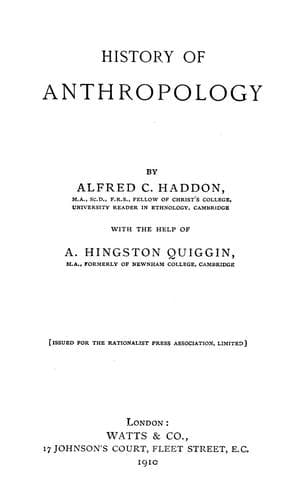
History of anthropologyHaddon, Alfred C. (Alfred Cort)
History
History of anthropology
Haddon, Alfred C. (Alfred Cort)
Anthropology -- History
Other classifications, by means of cultural distinctions, have been
attempted. Among these may be noted that based on mythology and religion
of Max Müller, on institutions and social organisation of Morgan and
Ratzel, or on musical systems of Fétis.
[Sidenote: =Hippocrates.=]
Hippocrates (_c._ 460-377), in his work, _About Air, Water, and Places_,
first discusses the influence of environment on man, physical, moral,
and pathological. He divided mankind into groups, impressed with
homogeneous characters by homogeneous surroundings, demonstrating that
mountains, plains, damp, aridity, and so on, produced definite and
varying types.
[Sidenote: =Bodin.=]
Bodin, writing in 1577 _Of the Lawes and Customes of a Common Wealth_
(English edition, 1605), contains, as Professor J. L. Myres has pointed
out,[128] “the whole pith and kernel of modern anthropo-geography....
His climatic contrasts are based on the Ptolemaic geography ... and he
argues as if the world broke off short at Sahara.... On his
classification of environments from arctic North to tropic South” he
superposes “a cross-division by grades of culture from civil East to
barbaric West.”
Footnote 128:
_Rept. Brit. Assoc._, 1909 (1910), p. 593.
[Sidenote: =Buffon.=]
Buffon followed Hippocrates. Man, said Buffon, consists of a single
species. Individual variations are due to three causes—climate, food,
and habits. These influences, acting over large areas on large groups of
people, produce general and constant varieties. To these varieties he
gave the name of _race_. This doctrine was the main support of the
monogenists.
[Sidenote: =Alexander von Humboldt, Ritter, and Waitz.=]
The year 1859 marks a crisis in this field of research, as in so many
others. Alexander von Humboldt (1769-1859), the Prussian naturalist and
traveller, spent the later part of his life in writing his classic
_Kosmos_, a summary and exposition of the laws and conditions of the
physical universe. Karl Ritter (1779-1859), Professor of Geography at
the University of Berlin, published, between 1822 and his death, the ten
volumes of _Die Erdkunde im Verhältniss zur Natur und zur Geschichte des
Menschen_. These works formed the basis from which was developed the
German view of geography as a science of the co-relation of
distribution. In 1859 Waitz, in his _Anthropologie der Naturvölker_,
insisted on the inter-relation between the physical organisation and the
psychic life of mankind.
[Sidenote: =Buckle.=]
Public-domain text, read in full here on John Shaqi.
Reviews
Reviews
No reviews yet
Be the first to share your thoughts on this work.
Elsewhere in the archive
Join the Discussion
Join the discussion
Sign in to leave a comment or review.
Sign InorCreate an account