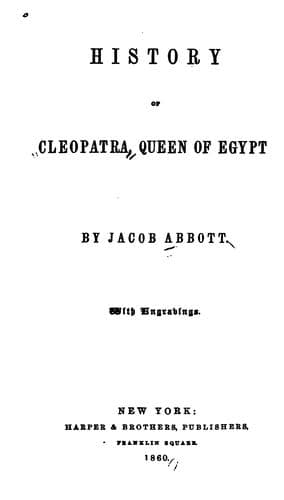
Cleopatra, Queen of Egypt, -30 B.C.; Egypt -- History -- 332-30 B.C. -- Biography; Queens -- Egypt -- Biography
Antony was distressed and agitated beyond measure by the entanglements in
which he found that he was involved. His duty, his inclination perhaps,
certainly his ambition, and every dictate of prudence and policy, required
that he should break away from these snares at once and go to meet
Octavia. But the spell that bound him was too mighty to be dissolved. He
yielded to Cleopatra's sorrows and tears. He dispatched a messenger to
Octavia, who had by this time reached Athens, in Greece, directing her not
to come any farther. Octavia, who seemed incapable of resentment or anger
against her husband, sent back to ask what she should do with the troops,
and money, and the military stores which she was bringing. Antony directed
her to leave them in Greece. Octavia did so, and mournfully returned to
her home.
As soon as she arrived at Rome, Octavius, her brother, whose indignation
was now thoroughly aroused at the baseness of Antony, sent to his sister
to say that she must leave Antony's house and come to him. A proper
self-respect, he said, forbade her remaining any longer under the roof of
such a man. Octavia replied that she would not leave her husband's house.
That house was her post of duty, whatever her husband might do, and there
she would remain. She accordingly retired within the precincts of her old
home, and devoted herself in patient and uncomplaining sorrow to the care
of the family and the children. Among these children was one young son of
Antony's, born during his marriage with her predecessor Fulvia. In the
mean time, while Octavia was thus faithfully though mournfully fulfilling
her duties as wife and mother, in her husband's house at Rome, Antony
himself had gone with Cleopatra to Alexandria, and was abandoning himself
once more to a life of guilty pleasure there. The greatness of mind which
this beautiful and devoted wife thus displayed, attracted the admiration
of all mankind. It produced, however, one other effect, which Octavia must
have greatly deprecated. It aroused a strong and universal feeling of
indignation against the unworthy object toward whom this extraordinary
magnanimity was displayed.
Public-domain text, read in full here on John Shaqi.
Reviews
Reviews
No reviews yet
Be the first to share your thoughts on this work.
Elsewhere in the archive
Join the Discussion
Join the discussion
Sign in to leave a comment or review.
Sign InorCreate an account