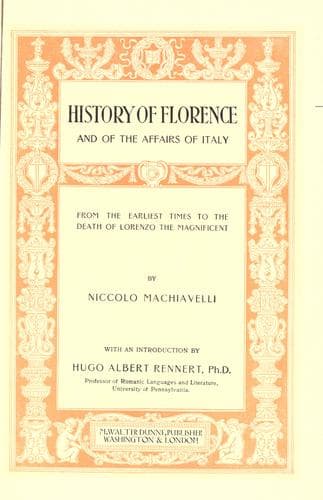
History of Florence and of the Affairs of Italy: From the Earliest Times to the Death of Lorenzo the MagnificentMachiavelli, Niccolò
Philosophy
History of Florence and of the Affairs of Italy: From the Earliest Times to the Death of Lorenzo the Magnificent
Machiavelli, Niccolò
Florence (Italy) -- History; Italy -- History -- 476-1492; Italy -- Politics and government
After the death of Urban, Pascal II. became pope, and the empire was
under the dominion of Henry IV. who came to Rome pretending friendship
for the pontiff but afterward put his holiness and all his clergy in
prison; nor did he release them till it was conceded that he should
dispose of the churches of Germany according to his own pleasure. About
this time, the Countess Matilda died, and made the church heir to all
her territories. After the deaths of Pascal and Henry IV. many popes and
emperors followed, till the papacy was occupied by Alexander III. and
the empire by Frederick, surnamed Barbarossa. The popes during this
period had met with many difficulties from the people of Rome and
the emperors; and in the time of Barbarossa they were much increased.
Frederick possessed military talent, but was so full of pride that he
would not submit to the pontiff. However, at his election to the empire
he came to Rome to be crowned, and returned peaceably to Germany, where
he did not long remain in the same mind, but came again into Italy to
subdue certain places in Lombardy, which did not obey him. It happened
at this time that the cardinal St. Clement, of a Roman family, separated
from Alexander, and was made pope by some of the cardinals. The Emperor
Frederick, being encamped at Cerma, Alexander complained to him of the
anti-pope, and received for answer, that they were both to go to him,
and, having heard each side, he would determine which was the true pope.
This reply displeased Alexander; and, as he saw the emperor was inclined
to favor the anti-pope, he excommunicated him, and then fled to Philip,
king of France. Frederick, in the meantime, carrying on the war in
Lombardy, destroyed Milan; which caused the union of Verona, Padua, and
Vicenza against him for their common defense. About the same period the
anti-pope died, and Frederick set up Guido of Cremona, in his stead.
Public-domain text, read in full here on John Shaqi.
Reviews
Reviews
No reviews yet
Be the first to share your thoughts on this work.
Join the Discussion
Join the discussion
Sign in to leave a comment or review.
Sign InorCreate an account