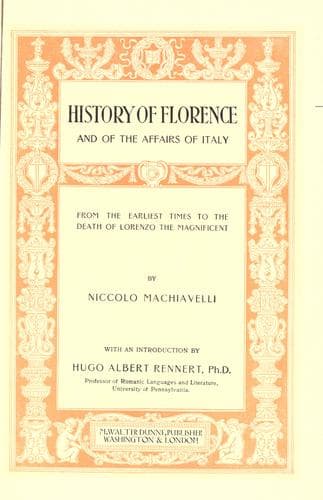
History of Florence and of the Affairs of Italy: From the Earliest Times to the Death of Lorenzo the Magnificent — John Shaqi
History of Florence and of the Affairs of Italy: From the Earliest Times to the Death of Lorenzo the MagnificentMachiavelli, Niccolò
Philosophy
History of Florence and of the Affairs of Italy: From the Earliest Times to the Death of Lorenzo the Magnificent
Machiavelli, Niccolò
Florence (Italy) -- History; Italy -- History -- 476-1492; Italy -- Politics and government
The Romans, from the absence of the pope, and from the emperor being
in Lombardy, had reacquired some authority in Rome, and proceeded to
recover the obedience of those places which had been subject to them.
And as the people of Tusculum refused to submit to their authority, they
proceeded against them with their whole force; but these, being assisted
by Frederick, routed the Roman army with such dreadful slaughter,
that Rome was never after either so populous or so rich. Alexander now
returned to the city, thinking he could be safe there on account of
the enmity subsisting between the Romans and the emperor, and from the
enemies which the latter had in Lombardy. But Frederick, setting aside
every other consideration, led his forces and encamped before Rome; and
Alexander fled to William, king of Puglia, who had become hair of that
kingdom after the death of Roger. Frederick, however, withdrew from Rome
on account of the plague which then prevailed, and returned to Germany.
The cities of Lombardy in league against him, in order to command Pavia
and Tortona, which adhered to the imperial party, built a city, to be
their magazine in time of war, and named in Alexandria, in honor of the
pope and in contempt of Frederick.
Guido the anti-pope died, and Giovanni of Fermo was appointed in his
stead, who, being favored by the imperialists, lived at Montefiascone.
Pope Alexander being at Tusculum, whither he had been called by the
inhabitants, that with his authority he might defend them from the
Romans, ambassadors came to him from Henry, king of England, to signify
that he was not blamable for the death of Thomas à Becket, archbishop
of Canterbury, although public report had slandered him with it. On this
the pope sent two cardinals to England, to inquire into the truth of
the matter; and although they found no actual charge against the king,
still, on account of the infamy of the crime, and for not having honored
the archbishop so much as he deserved, the sentence against the king of
England was, that having called together the barons of his empire,
he should upon oath before them affirm his innocence; that he should
immediately send two hundred soldiers to Jerusalem, paid for one year;
that, before the end of three years, he should himself proceed thither
with as large an army as he could draw together; that his subjects
should have the power of appealing to Rome when they thought proper;
and that he should annul whatever acts had been passed in his kingdom
unfavorable to ecclesiastical rule. These terms were all accepted by
Henry; and thus a great king submitted to a sentence that in our day a
private person would have been ashamed of. But while the pope exercised
so great authority over distant princes, he could not compel obedience
from the Romans themselves, or obtain their consent that he should
remain in Rome, even though he promised to intermeddle only with
ecclesiastical affairs.
Public-domain text, read in full here on John Shaqi.
Reviews
Reviews
No reviews yet
Be the first to share your thoughts on this work.
Join the Discussion
Join the discussion
Sign in to leave a comment or review.
Sign InorCreate an account