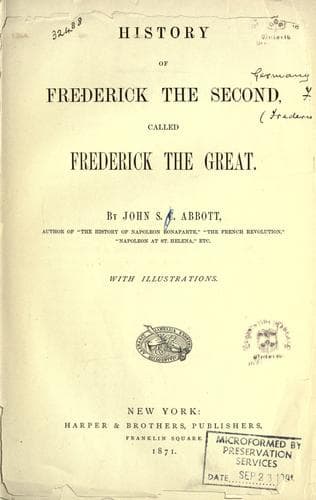
History of Frederick the Second, Called Frederick the Great.Abbott, John S. C. (John Stevens Cabot)
History
History of Frederick the Second, Called Frederick the Great.
Abbott, John S. C. (John Stevens Cabot)
Frederick II, King of Prussia, 1712-1786; Prussia (Germany) -- History -- Frederick II, 1740-1786
The treaty of Breslau was signed on the 11th of June, and ratified at
Berlin on the 28th of July. By this treaty, Silesia, Lower and Upper,
was ceded to “Frederick and his heirs for evermore,” while Frederick
withdrew from the French alliance, and entered into friendly relations
with her Hungarian majesty. Immediately after the settlement of this
question, Frederick, cantoning his troops in Silesia, returned to
Berlin. Elate with victory and accompanied by a magnificent suite, the
young conqueror hastened home, over green fields and beneath a summer’s
sun. Keenly he enjoyed his triumph, greeted with the enthusiastic
acclaim of the people in all the towns and villages through which he
passed.[67] At Frankfort-on-the-Oder, where a fair was in operation,
the king stopped for a few hours. Vast crowds, which had been drawn to
the place by the fair, lined the highway for a long distance on both
sides, eager to see the victor who had aggrandized Prussia by adding a
large province to its realms.
“His majesty’s entrance into Frankfort,” writes M. Bielfeld, who
accompanied him, “although very triumphant, was far from ostentatious.
We passed like lightning before the eyes of the spectators, and were
so covered with dust that it was difficult to distinguish the color
of our coats and the features of our faces. We made some purchases at
Frankfort, and the next day arrived safely in Berlin, where the king
was received with the acclamations of his people.”[68]
If we can rely upon the testimony of Frederick, an incident occurred
at this time which showed that the French court was as intriguing and
unprincipled as was his Prussian majesty. It is quite evident that the
Austrian court also was not animated by a very high sense of honor.
After the battle of Chotusitz, Frederick called upon General Pallant,
an Austrian officer, who was wounded and a prisoner. In the course of
the conversation, General Pallant stated that France was ready at any
moment to betray his Prussian majesty, and that, if he would give him
six days’ time, he would furnish him with documentary proof. A courier
was instantly dispatched to Vienna. He soon returned with a letter
from Cardinal Fleury, the prime minister of Louis XV., addressed to
Maria Theresa, informing her that, if she would give up Bohemia to the
emperor, France would _guarantee to her Silesia_. Frederick, though
guilty of precisely the same treachery himself, read the document with
indignation, and assumed to be as much amazed at the perfidy as he
could have been had he been an honest man.
“The cardinal,” he said, “takes me for a fool. He wishes to betray me.
I will try and prevent him.”
The French marshal, Belleisle, alarmed by the report that Frederick was
entering into a treaty of peace with Austria, hastened to the Prussian
camp to ascertain the truth or falsehood of the rumor. Frederick,
emboldened by the document he had in his pocket, was very frank.
Public-domain text, read in full here on John Shaqi.
Reviews
Reviews
No reviews yet
Be the first to share your thoughts on this work.
Elsewhere in the archive
Join the Discussion
Join the discussion
Sign in to leave a comment or review.
Sign InorCreate an account