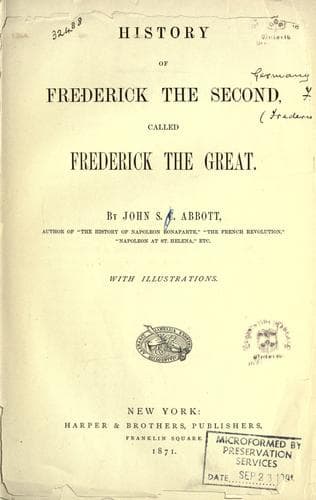
History of Frederick the Second, Called Frederick the Great.Abbott, John S. C. (John Stevens Cabot)
History
History of Frederick the Second, Called Frederick the Great.
Abbott, John S. C. (John Stevens Cabot)
Frederick II, King of Prussia, 1712-1786; Prussia (Germany) -- History -- Frederick II, 1740-1786
Along the eastern edge of this vast wilderness the army of Frederick
marched for two days. But Hungarian Pandours in swarms, savage men on
their fleet and shaggy horses, were continually emerging from the paths
of the forest, with gleaming sabres and shrill war-cries, assailing the
flank of the Prussian line wherever there was the slightest exposure.
In the vicinity of the little village of Sohr the king encamped for two
days. The halt seemed necessary to refresh his horses, and to send out
foraging parties to replenish his stores. But the light horsemen of
the foe were so thick around him, so vigilant, and so bold, that no
baggage train could enter his camp unless protected by eight thousand
foot and three thousand horse.
Just at the break of day of Thursday morning, September 30, as the king
was in his tent, busy with his generals, examining maps in preparation
for the immediate resumption of the march, an orderly came, in
breathless haste, to inform the king that the Austrians were advancing
rapidly upon him, and in great force. While he was yet speaking
another messenger arrived, confirming the tidings, and stating that,
apparently, the whole Austrian army, in battle array, was coming down
upon him.
It was a cold, dreary autumnal morning. The Austrian army, according to
Frederick’s statement, amounted to sixty thousand men.[86] But it was
widely dispersed. Many of the cavalry were scouring the country in all
directions, in foraging parties and as skirmishers. Large bodies had
been sent by circuitous roads to occupy every avenue of retreat. The
consolidated army, under Prince Charles, now advancing to the attack,
amounted to thirty-six thousand men. Frederick had but twenty-six
thousand.[87]
In this hour of peril the genius of the Prussian monarch was remarkably
developed. He manifested not the slightest agitation or alarm. His plan
was immediately formed. Indeed, there was no time for a moment’s delay.
The Austrians had moved rapidly and silently, concealing their approach
by a thick veil of hussars. They were already in solid columns,
confident of victory, advancing upon the Prussian camp. Frederick
was compelled to form his line of battle under fire of the Austrian
batteries. The discipline of the Prussians was such that this was done
with a recklessness of danger, rapidity, and mechanical precision which
seemed almost miraculous, and which elicited the admiration of every
one who beheld it.
The reader would not be interested in the details of the battle which
ensued. It lasted for five hours. It was, as is every battle, an
indescribable scene of tumult, uproar, and confusion. The result was
long doubtful. Defeat to Frederick would have been utter ruin. It is
wonderful how one determined man can infuse his spirit into a whole
host. Every Prussian seemed to have the same desperate valor, and
determination to conquer or to die, which animated his king.
Public-domain text, read in full here on John Shaqi.
Reviews
Reviews
No reviews yet
Be the first to share your thoughts on this work.
Elsewhere in the archive
Join the Discussion
Join the discussion
Sign in to leave a comment or review.
Sign InorCreate an account